

Internal vs External Links: What They Are and How to Use Them in SEO
Links are one of the basic building blocks of SEO, but many websites still use them without a clear strategy. Some pages are overloaded with internal links that add little value. Others point externally without much thought about relevance, trust, or user experience.
That becomes a problem because links do more than connect pages. They help search engines understand site structure, topic relationships, and content relevance. They also guide users through your website and out to supporting resources when needed.
If you want to improve rankings, strengthen topical authority, and build a cleaner content architecture, you need to understand internal vs external links properly. They do different jobs, and both matter.
This article explains the difference between internal and external links, why each type matters, how they work in practice, and what businesses should do to use them strategically.
What Are Internal vs External Links?
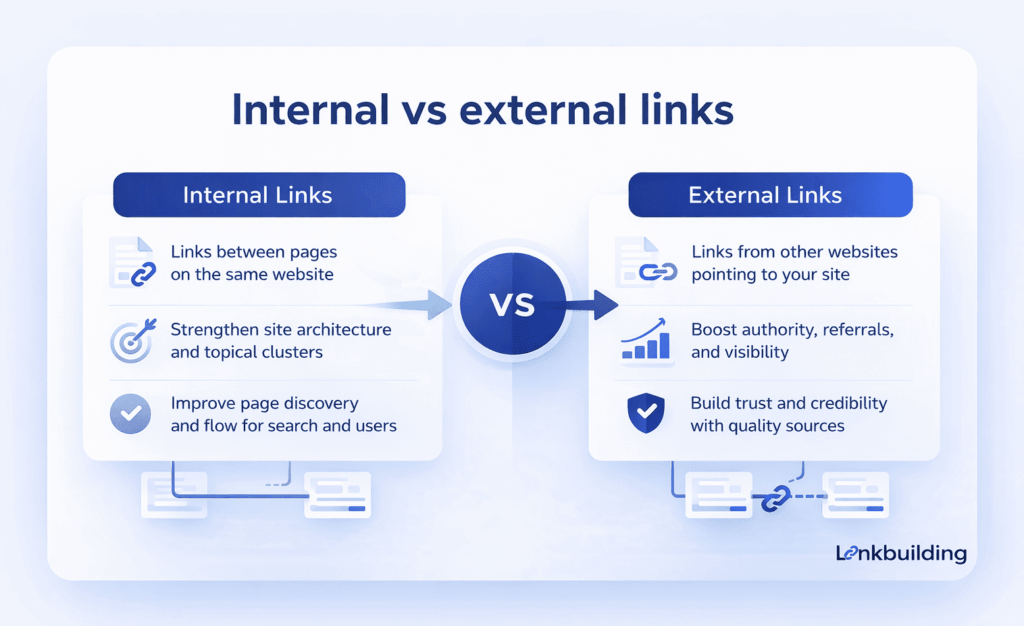
Internal vs external links refers to the difference between links that point within your own website and links that point to other websites.
An internal link connects one page on your domain to another page on the same domain. For example, a blog post about backlinks might link to another article on anchor text or to your main linkbuilding guide.
An external link points from your website to a page on a different domain. For example, you might cite a search engine guideline, an industry study, or a relevant third-party source.
There is also a related term that often causes confusion: backlinks. A backlink is an external link from another website pointing to your site. So when comparing internal vs external links, it helps to separate outgoing external links from incoming backlinks.
Internal links
Internal links help connect your site’s pages into a usable, understandable structure.
They help with:
- navigation
- crawl paths
- topic relationships
- authority distribution
- conversion journeys
In a pillar-and-cluster model, internal links are especially important because they connect broad pillar pages with supporting cluster articles and related commercial pages.
External links
External links point users and search engines toward pages outside your own site.
They are useful for:
- citing trustworthy sources
- adding context
- supporting claims
- improving usefulness for readers
- showing editorial depth
Used well, external links can strengthen content quality. Used poorly, they can look careless, irrelevant, or distracting.
Why Internal vs External Links Matter
This topic matters because internal and external links influence SEO in different ways.
Internal links help search engines understand your website from the inside. External links help place your content in a broader context across the web.
A site that handles both well tends to be easier to crawl, easier to understand, and more useful to readers.
Internal links support site architecture
Internal links are one of the clearest ways to show search engines which pages matter, how topics relate, and where authority should flow.
If your site has strong content but weak internal linking, search engines may struggle to interpret your structure properly. Important pages can end up under-supported, and topic clusters can feel disconnected.
External links support trust and context
External links matter because they show that your content is grounded in a wider ecosystem of information. In some cases, linking out to helpful, relevant sources improves the completeness and credibility of the page.
This is especially important on informational content where users benefit from deeper context, definitions, or references.
Both affect user experience
The SEO value of links is only part of the picture. Good links also make content easier to use.
Internal links help readers move naturally to the next relevant page. External links help them verify information or explore supporting resources. When both are used thoughtfully, the page becomes more useful and more credible.
How Internal vs External Links Work
Internal and external links work differently because they serve different structural roles.
How internal links work
Internal links connect pages within the same domain. They help search engines crawl more of your site and understand the hierarchy between pages.
They also help distribute authority. If one page earns strong backlinks, internal links can help pass some of that value toward related pages.
This is one reason internal linking is central to cluster SEO. A strong pillar page can connect to cluster articles, and those cluster pages can link back to the pillar and across related subtopics. That makes the whole topic area stronger.
Internal links help define importance
If a page is linked repeatedly from relevant sections of your site, that can signal that it matters.
This does not mean every page should link to everything. It means your internal links should reflect real topic relationships and business priorities.
Internal links shape crawl efficiency
Search engines use internal links to discover and revisit pages. If valuable pages are buried or poorly linked, they may receive less attention than they should.
Good internal linking reduces isolation and helps important content stay visible within the site structure.
How external links work
External links send users and search engines from your site to another domain.
They do not distribute authority within your own site the way internal links do, but they can support quality and relevance when used well.
For example, linking to official documentation, a respected publication, or a useful source can strengthen the usefulness of your page. It shows you are not making unsupported claims in isolation.
External links add editorial context
A well-placed external link can help clarify a definition, support a technical point, or direct users to a primary source.
That is different from linking out randomly. The value comes from relevance and editorial intent.
External links should be selective
Linking externally does not mean filling pages with unnecessary references. Too many external links can distract users and weaken the reading flow. The goal is to add value, not clutter.
Important Differences Between Internal and External Links
Understanding internal vs external links is easier when you look at the practical differences.
Control
You have full control over internal links. You decide where they go, what anchor text they use, and how often they appear.
You do not control backlinks from other sites, and you only partly control external linking decisions on your own pages because their value depends on the credibility and stability of the destination source.
Strategic purpose
Internal links mainly support architecture, discoverability, and authority flow within your site.
External links mainly support context, trust, and usefulness by connecting your content to other relevant sources.
SEO role
Internal links help reinforce topical structure and direct search engines toward priority pages.
External links help support content quality and contextual relevance, while backlinks from other sites remain one of the key off-page authority signals in SEO.
Common Mistakes
Many websites do not have a link problem because they lack links. They have a link problem because they use them without structure.
Using internal links without clear hierarchy
Some sites add internal links wherever possible, without considering whether the linked pages are actually related. That creates noise rather than clarity.
Internal links should support the content journey and the site architecture, not just increase link count.
Overusing exact-match anchor text
This mistake happens with both internal and external links. Repeating the same keyword-rich anchor text over and over can look forced and reduce readability.
Natural variation is usually stronger and more useful.
Linking externally to weak sources
Not every source deserves a link. Linking to low-quality, irrelevant, or unreliable pages can weaken the usefulness of your content.
External links should support trust, not undermine it.
Ignoring orphan pages
An orphan page has little or no internal linking support. Even strong content can underperform if it sits outside the main site structure.
Treating all links as equal
An internal link to a strategic cluster article is not the same as a footer link to a low-priority page. An external link to an official source is not the same as a casual link to a weak blog post.
Link quality, placement, and context matter.
Practical Guidance for Using Internal and External Links
If you want to use internal vs external links well, start with purpose.
Ask what the link is supposed to do.
If the goal is to move the reader deeper into your own topic cluster, an internal link is probably the right choice. If the goal is to support a claim or reference a useful outside resource, an external link may make sense.
Build internal links around topic relationships
Your internal links should reflect the structure of the site.
A practical pattern for cluster SEO is:
- pillar pages link to core cluster articles
- cluster pages link back to the pillar
- related cluster pages cross-link where relevance is genuine
- informational pages connect to appropriate commercial pages when helpful
This creates a clearer topical map for both users and search engines.
Use external links to strengthen content quality
External links are most useful when they improve the page for the reader.
Good reasons to link externally include:
- citing a primary source
- referencing official guidance
- supporting a nuanced point
- giving users access to a useful tool or resource
That is very different from adding external links simply because they seem good for SEO.
Keep anchor text natural
For both internal and external links, anchor text should describe the destination naturally without feeling mechanical. Clear, readable anchors are usually better than aggressively optimized ones.
Timing and Expectations
Changes to internal linking can sometimes influence SEO relatively quickly, especially on sites with crawl or structure issues. Search engines can discover improved relationships between pages as they recrawl the site.
The impact of external linking is often less direct. Linking out to good sources can improve content quality and trust signals, but it is not usually a standalone ranking lever in the way internal architecture can be.
In both cases, the results depend on context. Stronger linking supports stronger SEO, but only when the pages themselves are useful, relevant, and aligned with search intent.
Conclusion
Internal vs external links is not just a technical distinction. It is a strategic one.
Internal links help shape your site from the inside. They connect pages, distribute authority, and strengthen topical architecture. External links help place your content in context. They support trust, usefulness, and editorial depth when they point to credible sources.
The strongest SEO strategies use both deliberately. They do not link excessively, and they do not link randomly. They build clear internal pathways and use external references where they genuinely improve the page.
When that balance is handled well, links become more than navigation elements. They become part of how your website communicates relevance, structure, and trust.