

Google Penalties and Backlinks: How Bad Links Can Affect Rankings and What to Do About It
Backlinks can help a website build authority, but they can also create problems when they come from manipulative tactics, spammy sources, or patterns that search engines treat as attempts to influence rankings unnaturally. That is why Google penalties and backlinks are closely connected in SEO discussions.
The important nuance is that not every bad backlink automatically leads to a direct penalty. Google’s current systems often try to ignore or neutralize spammy links algorithmically. At the same time, Google’s spam policies make clear that links intended to manipulate rankings are considered link spam, and policy violations can still lead to lower rankings or removal from Search results. Google also still documents manual actions as a form of human-applied enforcement when a site violates its policies. (Google for Developers)
For businesses, marketers, and SEO professionals, this means two things. First, backlink quality still matters. Second, the real risk is broader than the old idea of a single “penalty.” A site can lose visibility because spammy links are ignored, because ranking systems discount manipulative signals, or because Google applies a manual action. That is why a smart backlink strategy is not only about gaining links. It is also about avoiding the kinds of links that create long-term instability.
This article explains what Google penalties and backlinks mean in practice, how Google currently handles spammy links, what kinds of backlink patterns can create risk, how manual actions differ from algorithmic effects, what common mistakes to avoid, and how to approach linkbuilding more safely. It follows the provided writing guidance for an informational cluster page.
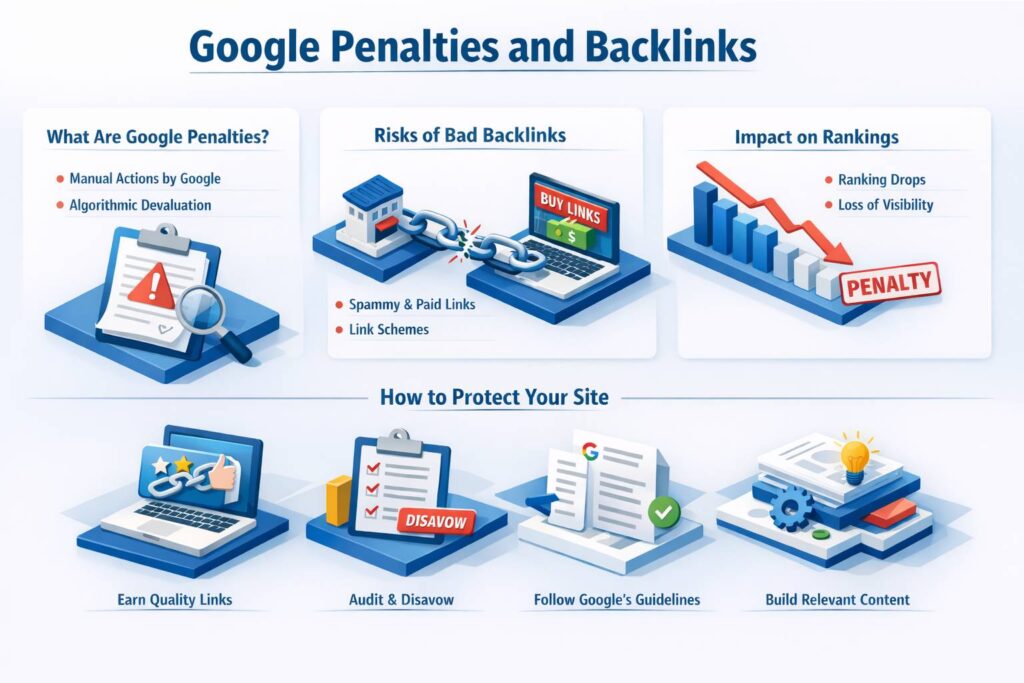
What Are Google Penalties and Backlinks?
Google penalties and backlinks refers to the relationship between a website’s backlink profile and the possibility of losing visibility in Google Search because of link-related problems.
In practice, people often use the word “penalty” too broadly. There are at least three different situations that get grouped together:
- a manual action, where Google’s human reviewers determine that pages or a site violate spam policies
- an algorithmic devaluation, where Google’s systems discount or ignore unnatural links
- a ranking loss after a spam update, where improvements in Google’s spam systems reduce the effect of manipulative tactics
These situations are not identical, but they all matter when evaluating backlinks. Google’s spam policies explicitly list link spam as a violation when links are intended to manipulate rankings, and Google’s documentation says sites violating spam policies may rank lower or be omitted from Search results. Google’s spam updates documentation also says that if spammy links benefited a site before, those links may no longer count after improved detection, which can lead to ranking drops even without a visible manual penalty. (Google for Developers)
So when people talk about “Google penalties backlinks,” they are often describing any negative SEO effect tied to unnatural or spammy links, even if the mechanism is different.
Why It Matters
Google penalties and backlinks matter because backlinks remain a meaningful part of how search engines evaluate pages, especially in competitive areas. That creates strong incentives to build links quickly, but not every way of acquiring links is safe or durable.
Bad links can create direct or indirect visibility loss
A manipulative backlink profile can create problems in more than one way. In some cases, Google may apply a manual action. In other cases, Google may simply stop counting the links or reduce their value through spam systems. Either way, the site can lose organic visibility. (Google for Developers)
Short-term gains can disappear
One of the biggest problems with risky link tactics is that they can create performance that looks real but is fragile. If a site benefits from unnatural links and Google’s systems later neutralize those signals, rankings can fall even if the site was never formally notified of a manual action. Google’s spam updates page explicitly explains that when spammy links are no longer counted, any ranking credit from them is lost. (Google for Developers)
A weak link profile affects broader site strategy
A site that depends heavily on manipulative links often underinvests in stronger foundations such as useful content, digital PR, linkable assets, and internal linking. That makes the overall SEO strategy less resilient.
It influences topical authority
In a pillar-and-cluster model, backlinks should reinforce a wider content structure. If links are weak, spammy, or unstable, they are less useful for supporting related pages through internal linking and broader topical authority. That matters for any site trying to build long-term organic visibility.
How Google Handles Bad Backlinks Today
This is the part many site owners misunderstand.
Google’s current public guidance suggests that its systems are often designed to detect and neutralize spammy links rather than always applying obvious penalties. Google’s spam updates documentation says that if a site appears to lose rankings after a spam update, it may be because spammy links that were once passing value are no longer counted. (Google for Developers)
At the same time, Google still maintains manual actions for policy violations. Its spam policies say that violating spam policies can lead to lower rankings or removal from Search, and Search Console documentation around manual actions explains that these are human-applied actions taken when pages do not comply with Google’s spam policies. (Google for Developers)
That means a backlink problem can show up in two main ways:
Manual action
A human reviewer determines that the site is violating spam policies, such as through unnatural links or other manipulative tactics. This is the clearest version of a Google penalty in the traditional sense. If a site receives a manual action, it is usually visible in Search Console.
Algorithmic devaluation or spam system impact
Google’s ranking systems and spam systems may simply ignore or reduce the value of unnatural links. The site may lose rankings because those links stop helping. This can feel like a penalty from the outside, even if it is actually a removal of artificial advantage rather than a manual punishment. (Google for Developers)
What Kinds of Backlinks Create Risk?
Google’s spam policies specifically identify a range of link practices that count as link spam when intended to manipulate rankings. These include buying or selling links for ranking purposes, excessive link exchanges, large-scale article marketing or guest posting with keyword-rich anchor text, and links created using automated programs or services. (Google for Developers)
In practical SEO terms, backlink risk often increases when you see patterns like these:
- paid links intended to pass ranking signals
- large numbers of irrelevant directory or resource links
- private network style links
- repeated exact-match anchor text across many domains
- mass guest posting on low-quality sites
- automated link creation
- comment spam or forum spam
- links from obviously spammy or hacked pages
The issue is not just that these tactics exist. The issue is that they usually create patterns that are hard to defend as real editorial choice.
Important Subtopics Within Google Penalties Backlinks
Manual actions
Manual actions are the most explicit form of enforcement. They are applied by Google’s human reviewers when a site violates spam policies. This is the version of a penalty that site owners most often picture, because it can show up directly in Search Console and often requires cleanup and reconsideration. (Google for Developers)
Link spam systems
Google’s spam systems are continuously working, and spam updates are occasional notable improvements to those systems. Google explains that when those systems get better, sites that relied on spammy links may lose any benefit those links were passing. (Google for Developers)
Paid links and qualification
Google’s documentation on qualifying outbound links says that paid or sponsored links should use rel="sponsored" or rel="nofollow". That matters because unqualified paid links intended to influence rankings sit directly inside the category of link spam risk. (Google for Developers)
Natural links versus manipulative links
Google’s site position FAQ says the best way to get people to link to your site naturally is to create unique, compelling content that others want to link to, and notes that Google is good at detecting unnatural links that violate spam policies. That is still one of the clearest strategic distinctions in backlink quality. (Google for Developers)
Common Mistakes
Assuming every bad backlink causes a manual penalty
This is one of the biggest misconceptions. Many spammy links are likely discounted algorithmically rather than triggering an obvious manual action. The result can still be ranking loss, but the mechanism may be different. (Google for Developers)
Treating temporary gains as safe
A link tactic producing results now may simply mean Google has not fully neutralized it yet. Spam updates exist precisely because Google keeps improving how it handles manipulation. (Google for Developers)
Focusing only on link quantity
A large backlink profile can still be weak if the links are low quality, irrelevant, or manipulated. A smaller number of credible, editorially earned links is usually more durable.
Ignoring anchor text patterns
Overly repetitive keyword-rich anchor text is one of the common signals that a link profile was engineered rather than earned naturally.
Building links without thinking about site structure
Even good links are underused if they point to isolated pages. The best backlink profiles support pages that then help the wider cluster through internal linking and clearer site architecture.
Practical Guidance
A practical way to think about Google penalties backlinks is to move away from the narrow question of “Will this get me penalized?” and toward a better question: “Would this link still make sense if ranking manipulation were not part of the equation?”
That is a useful filter because the closer a link is to genuine editorial choice, relevance, and user value, the less likely it is to create long-term problems.
For most websites, the safer approach is to build a backlink profile through:
- link-worthy content
- strong informational resources
- digital PR and outreach
- useful tools, research, or original data
- relevant editorial mentions
- consistent internal linking
That approach is slower, but it aligns better with Google’s stated preference for natural links earned through compelling content. It also supports the wider pillar-and-cluster model more effectively because the authority earned by one good page can support related pages through internal links.
If a site already has backlink concerns, the right response usually starts with identifying obvious manipulative patterns, stopping risky tactics, and prioritizing stronger long-term acquisition methods rather than trying to outpace the problem with more questionable links.
Timing and Expectations
Backlink-related problems do not always appear immediately. A site can build risky links for a while and still perform, especially if those links are temporarily passing value. But that does not mean the approach is stable.
Google’s spam updates documentation makes clear that changes in spam detection can remove the benefit of spammy links later, which means the ranking effect may show up long after the links were built. (Google for Developers)
That is one reason linkbuilding should be judged over a longer horizon. A tactic that appears efficient in the short term may be far less efficient once risk, cleanup, and lost visibility are accounted for.
Conclusion
Google penalties and backlinks are connected, but not always in the simplistic way many people assume. Bad backlinks can create problems through manual actions, through algorithmic discounting, or through spam systems that strip away artificial ranking benefit. Google’s current guidance makes clear that links intended to manipulate rankings violate spam policies, and that violating those policies can lead to reduced visibility or removal from Search. (Google for Developers)
The strategic takeaway is clear. The goal should not be to find link tactics that work until they stop working. The goal should be to build a backlink profile that remains valuable because it is based on relevance, editorial choice, and genuinely useful content. For a site building topical authority over time, that is the more durable path.