

Structured Data SEO: What It Is, Why It Matters, and How to Use It Properly
Structured data is one of the most useful technical SEO tools for helping search engines understand a page more clearly. It does not replace content quality, internal linking, or relevance. It also does not guarantee rankings or rich results. But when implemented properly, it improves clarity, strengthens page meaning, and can support enhanced search features that make listings more useful and more visible.
That is why structured data SEO matters. On many websites, the content itself is strong, but the page does not communicate its type, entities, or relationships clearly enough in machine-readable form. Search engines can still interpret a lot without markup, but structured data helps remove ambiguity. It makes it easier to identify whether a page is an article, product, FAQ, organization page, event, or something else entirely.
For websites building topical authority, that clarity is valuable. Strong content clusters benefit when pages are not only relevant to users, but also technically understandable to search engines. This article explains what structured data SEO is, why it matters, how it works, what often goes wrong, and how to approach it strategically.
What Is Structured Data SEO?
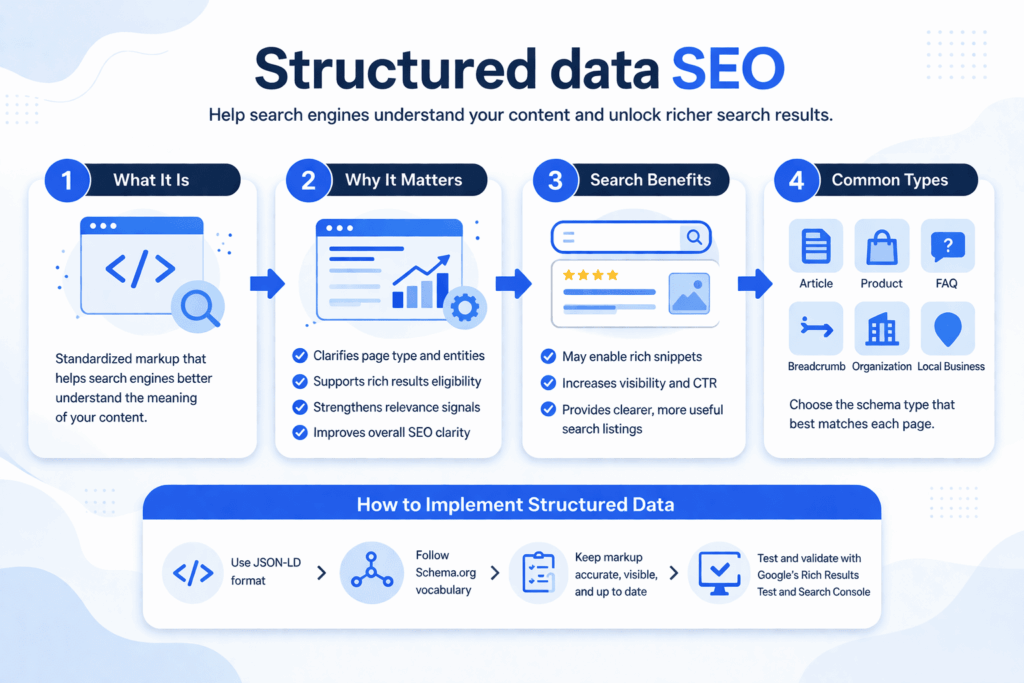
Structured data SEO is the practice of using standardized markup to help search engines interpret the meaning and attributes of a page more accurately.
In practical terms, structured data adds machine-readable context to a webpage. It tells search engines what the content represents, not just what words appear on the page.
For example, structured data can help indicate that a page contains:
- an article
- a product
- a breadcrumb trail
- an organization profile
- an FAQ section
- a review
- an event
- a recipe
- a local business listing
The most common format today is Schema.org markup implemented through JSON-LD. This allows websites to label entities, relationships, and content types in a structured way without changing the visible content itself.
Structured data SEO is not about adding as much markup as possible. It is about adding the right markup, accurately, in a way that reflects the actual page.
Why Structured Data SEO Matters
Structured data SEO matters because search engines work better when page meaning is explicit.
It helps search engines understand page context
A page may clearly look like a product page to a human, but search engines still benefit from machine-readable confirmation. Structured data makes that context more direct and more consistent.
This can be especially useful when websites have complex templates, multiple content types, or pages with overlapping intent.
It can support enhanced search results
Structured data may help pages become eligible for enhanced search features such as rich snippets, breadcrumbs, FAQs, product details, review information, and other visually improved search appearances.
Eligibility does not guarantee display, but it improves the chances that search engines can use the page in a richer way.
It strengthens entity clarity
Structured data can reinforce how search engines understand the entities connected to a page, such as a company, product, author, event, or location. That helps build consistency across the site and across related content.
It supports technical clarity across a content cluster
On a site using a pillar-and-cluster model, structured data can help different page types communicate their roles more clearly. Articles, FAQs, product pages, organization pages, and supporting resources all benefit when the markup matches their purpose.
How Structured Data SEO Works
Structured data SEO works by adding standardized labels to a page so search engines can interpret the content more accurately.
The markup itself is usually invisible to users, but search engines can read it when they crawl the page. They then use that information alongside visible content, internal linking, and other technical signals to understand what the page contains.
JSON-LD as the standard approach
The most common implementation method is JSON-LD placed in the page source. It is preferred because it is cleaner to manage, easier to validate, and less likely to interfere with visible layout or HTML structure.
Schema types and properties
Structured data uses defined types and properties from Schema.org. For example, an article page might use properties for headline, author, datePublished, and image. A product page might use product name, brand, price, and availability.
The important part is not memorizing every property. It is choosing the correct schema type and implementing the relevant fields accurately.
Alignment with visible content
Search engines compare markup to what users can actually see on the page. If the structured data claims the page contains reviews, FAQs, or product details that are not clearly present in the visible content, trust in the markup weakens.
This is one of the most important principles in structured data SEO: the markup should clarify the page, not exaggerate it.
Important Types of Structured Data
Article schema
Article markup is often useful for editorial content, blog posts, news pages, and long-form educational resources. It helps define the page as a content asset rather than a generic webpage.
Breadcrumb schema
Breadcrumb markup helps search engines understand the hierarchical path of a page within the site. This supports clearer navigation signals and can improve how the result is displayed in search.
FAQ schema
FAQ markup can be useful when a page genuinely includes a visible question-and-answer section. It should not be added mechanically to pages that do not actually contain a real FAQ block.
Product schema
Product markup helps define product-specific details such as name, availability, price, and brand. It is especially relevant for ecommerce pages.
Organization and local business schema
This markup helps define the company or business entity behind the site or page. It is useful for brand clarity, especially on homepage, about, and local business pages.
Review and rating schema
Review-related markup can be useful when legitimate review content is visible on the page and implemented in compliance with search engine guidelines.
Common Structured Data SEO Mistakes
Marking up content that is not actually visible
One of the most common mistakes is using schema to imply content exists when it is not truly on the page. This often happens with reviews, FAQs, and product details.
Using the wrong schema type
Some sites apply generic markup where a more precise type would be better, while others use overly specific types that do not really match the page. Both create unnecessary ambiguity.
Adding too much unnecessary markup
More markup is not always better. Structured data should clarify the main purpose of the page, not create noise by labeling every possible element.
Failing to maintain markup across templates
A site may implement structured data correctly once, then introduce template changes that leave fields outdated, incomplete, or broken. This is why structured data SEO should be reviewed at the template level, not only page by page.
Treating schema as a ranking trick
Structured data helps interpretation. It is not a substitute for useful content, strong technical SEO, or search intent alignment.
Practical Guidance for Using Structured Data Correctly
The best way to approach structured data SEO is to start with page type and user intent.
Ask what the page actually is. Is it an article, a product page, a category page, an FAQ resource, or an organization page? Then choose markup that accurately reflects that role.
From there, focus on three things:
- accuracy
- relevance
- consistency
The markup should describe the page as it truly exists. It should include the most useful properties for that page type. And it should be implemented consistently across the templates that use it.
For most websites, the best starting points are:
- article schema for editorial content
- breadcrumb schema for site hierarchy
- organization or local business schema for brand clarity
- FAQ schema where visible FAQ content exists
- product schema for ecommerce detail pages
It also helps to validate the markup after implementation and after major template changes. Structured data SEO is not a one-time add-on. It should be maintained as part of the website’s technical framework.
How Structured Data Fits Into a Broader SEO Strategy
Structured data works best when it supports a strong underlying page, not when it tries to compensate for a weak one.
A clear page structure, proper internal linking, good crawlability, and useful content still matter more. Structured data adds clarity to those strengths.
This topic also connects naturally to related cluster pages such as:
- technical SEO
- crawling and indexing
- canonical tag
- XML sitemap SEO
- URL structure SEO
- internal linking
- Core Web Vitals
That is useful in a pillar-and-cluster model because each page can stay focused while still reinforcing broader technical authority.
Timing and Expectations
Structured data changes can be processed relatively quickly once search engines recrawl the page, but outcomes vary.
In some cases, the benefit is mainly better clarity and stronger technical consistency. In other cases, pages may become eligible for richer search presentation. But it is important to stay realistic: structured data does not guarantee rich results, and it does not create ranking improvements on its own.
Its main value is that it helps search engines understand the page more precisely. That can support stronger visibility when the rest of the SEO foundation is already sound.
Conclusion
Structured data SEO matters because it gives search engines clearer, machine-readable context about what a page is and what it contains.
It does not replace good content, and it does not work as a shortcut to rankings. But it does improve technical clarity, supports eligibility for enhanced search features, and helps reinforce page meaning across a website.
For websites building topical authority, that matters. A strong site should not only publish useful pages. It should also make those pages easier for search engines to interpret correctly. When structured data is accurate, relevant, and aligned with visible content, it becomes a valuable part of that foundation.