
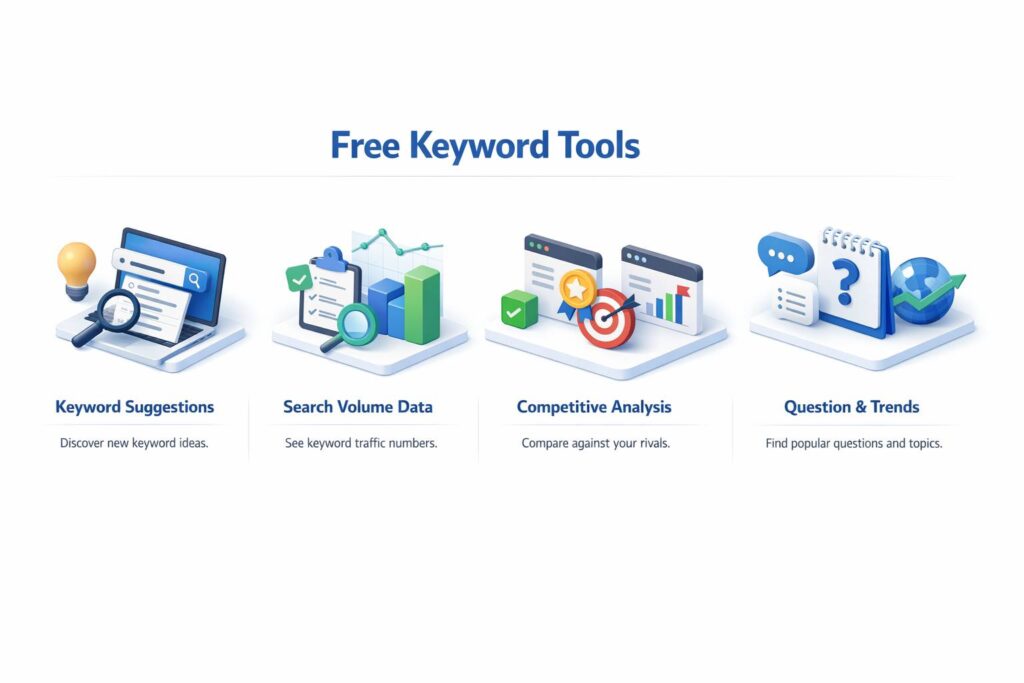

Free Keyword Tools
Free keyword tools are often the starting point for SEO research because they make search demand more accessible without requiring a paid platform. For small businesses, solo marketers, content teams, and newer websites, that matters. Not every SEO strategy begins with enterprise software. Many begin with a practical need: find relevant topics, understand what people search for, and decide which pages to create first.
That is why free keyword tools remain useful even for experienced SEO professionals. They may not provide the full depth of premium platforms, but they can still reveal valuable search patterns, related queries, content angles, and intent signals. Used well, they support better decisions around topic selection, keyword clustering, and content planning.
For a site building topical authority through a pillar-and-cluster model, this is especially important. Free keyword tools can help identify broad pillar themes, uncover supporting cluster topics, and show how users phrase their searches around a subject. This article follows the informational cluster-page brief and the writing standards you provided.
What Are Free Keyword Tools?
Free keyword tools are research resources that help identify search queries, related topics, and keyword ideas without requiring a paid subscription.
In practical terms, they help answer questions such as:
- What phrases do people search for?
- What related questions exist around a topic?
- How can a broad topic be broken into supporting subtopics?
- What type of content might match a query?
Some free keyword tools are dedicated SEO tools with limited free access. Others come from search engines themselves, such as autocomplete suggestions, related searches, and trend-based data sources. Not all of them provide the same features, and not all of them offer full volume or difficulty metrics, but they can still be very useful.
The key point is that free keyword tools are not substitutes for strategy. They are inputs. They help you see search behaviour more clearly, but you still need to interpret what that means for page structure, search intent, and content priorities.
Why Free Keyword Tools Matter
Free keyword tools matter because they lower the barrier to doing useful SEO research.
They make keyword discovery accessible
Many websites delay keyword research because they assume useful research requires expensive software. In reality, free tools can still uncover relevant topics, related searches, and supporting content angles.
That makes them especially useful for smaller teams, independent publishers, and early-stage websites that need direction before they need advanced reporting.
They help validate content ideas
A content idea may sound useful internally but still be weak from a search perspective. Free keyword tools help validate whether there is real search behaviour around the topic and how people phrase that interest.
This improves planning because the page can be built around actual demand rather than assumption alone.
They support cluster development
A topic cluster rarely emerges from one keyword. It grows from related questions, variations, and supporting themes. Free keyword tools can help uncover these layers.
For example, a broad topic like Keyword Research can expand into supporting pages on search intent, long-tail keywords, keyword mapping, choosing keywords, keyword research tools, and free keyword tools. That kind of structural expansion is central to the broader keyword research guide you uploaded.
They improve prioritisation even without full data
Free tools often provide less precision than paid platforms, but they still help prioritise content by showing recurring topics, query patterns, and related questions. Even limited data can be useful when interpreted well.
How Free Keyword Tools Work
Free keyword tools work by surfacing search behaviour signals that help users discover and evaluate topics.
They expand seed topics into keyword ideas
Most free tools begin with a broad topic or seed phrase. From there, they generate related queries, phrasing variations, or question-based searches.
This is useful because SEO rarely starts with a finished keyword map. It usually starts with a broad idea that needs expansion.
They reveal how users phrase searches
One of the biggest benefits of free keyword tools is language insight. They show how users express needs, problems, and questions in their own terms.
That helps marketers avoid relying too heavily on internal jargon when naming pages or planning content.
They support intent analysis indirectly
Free tools often reveal whether a topic is educational, comparative, local, or problem-based through the modifiers and related terms they surface. While they do not replace manual SERP review, they can point you toward the likely intent behind a topic.
They help uncover subtopics
A strong page often needs surrounding support content. Free keyword tools can show the wider ecosystem around a topic, making it easier to identify which subtopics might deserve cluster pages.
Important Types of Free Keyword Tools
Not all free keyword tools do the same job. Understanding the differences helps you use them more effectively.
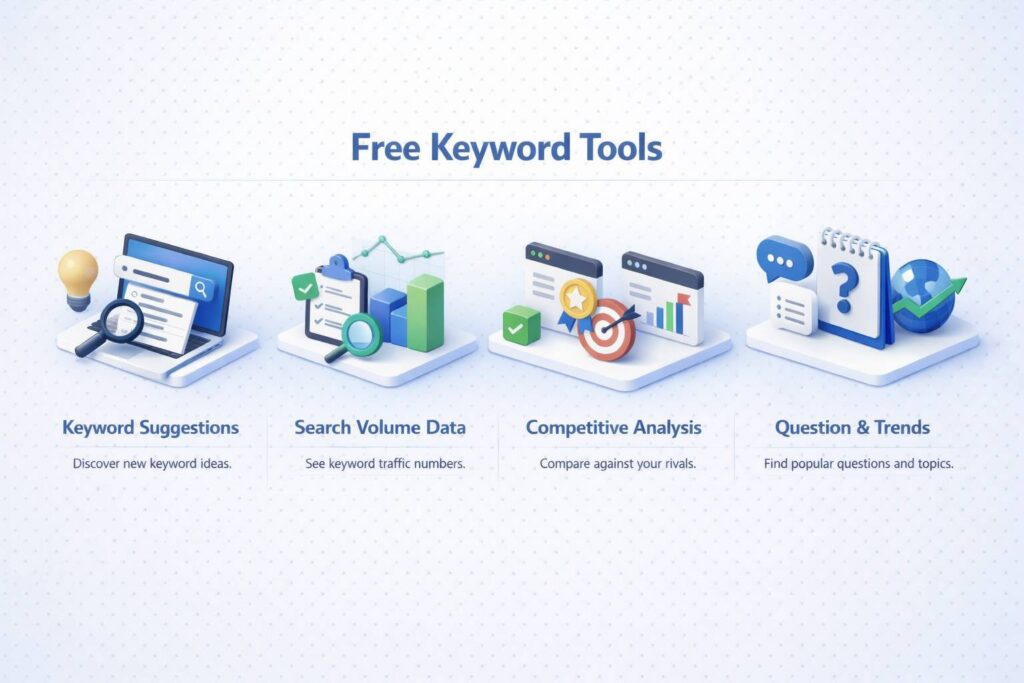
Search engine suggestion tools
These tools and sources show autocomplete phrases, related searches, and question-based expansions. They are useful because they often reflect real search behaviour very directly.
They can be especially helpful for:
- finding long-tail topics
- uncovering common phrasing
- generating content angles
- identifying related questions
Trend-based tools
Some free tools are better for spotting interest patterns over time. These are useful when comparing seasonal demand, topic growth, or shifts in search interest.
They do not always provide deep SEO metrics, but they can still improve topic prioritisation.
Limited-access SEO platforms
Some paid SEO platforms offer free versions, free trials, or restricted reports. These can sometimes provide volume estimates, competition clues, and related keyword suggestions without full subscription access.
They are useful when you need more structure than basic suggestion tools provide.
Question discovery tools
Some tools are best for surfacing common questions around a topic. These are especially useful for informational SEO, cluster development, and FAQ-style content planning.
Important Subtopics Within Free Keyword Tools
A strong page on free keyword tools should also address the concepts that affect how those tools are used.
Search volume context
Some free tools provide volume estimates, but many do not. Even when volume is available, it should be treated as directional rather than absolute. Volume can help compare opportunities, but it should not dominate every decision.
Search intent validation
Free tools can help suggest intent, but live search result review is still important. A query may look informational based on phrasing alone, but the actual results may reveal a stronger commercial or mixed intent pattern.
Topic clustering
Free keyword tools are often especially helpful for clustering because they surface related phrases and supporting angles. This can make it easier to decide which terms belong together on one page and which deserve separate pages.
Content prioritisation
Even limited keyword data can improve prioritisation. If a free tool consistently reveals related questions and supporting searches around a topic, that topic may deserve stronger investment than a page idea that remains vague and unsupported.
Common Mistakes With Free Keyword Tools
Free keyword tools are useful, but their limitations need to be understood.
Expecting enterprise-level depth
A common mistake is assuming free tools should deliver the same level of precision as paid SEO platforms. In many cases, they will not. Their value is often directional, not exhaustive.
Using the tool without checking the SERP
A free keyword tool may show a promising phrase, but the actual search results still need review. Search intent, dominant page format, and content quality in the SERP are all essential to interpreting whether the keyword is worth targeting.
Treating every suggestion as a separate page
Free tools often generate many variations around the same theme. Turning each one into a separate page usually leads to duplication and weak site structure. Similar terms often belong in one cluster.
Ignoring business relevance
A keyword can be interesting and still be the wrong fit. Free keyword tools should support strategic relevance, not distract from it. The best keyword opportunities are the ones that align with both search demand and the site’s goals.
Relying on one free source alone
Different free tools reveal different parts of the picture. Suggestion tools, trends tools, and SERP review often work best together rather than in isolation.
Practical Guidance for Using Free Keyword Tools Well
The best way to use free keyword tools is to combine them with judgment, intent analysis, and site structure planning.
Start with the main topic you want to cover. Then use free tools to discover related searches, supporting questions, and nearby subtopics. Review the search results to confirm intent and page type. After that, decide whether the keyword belongs on an existing page, a new cluster article, or a broader pillar topic.
A practical process usually looks like this:
- choose a seed topic
- use free tools to find related keywords and questions
- review recurring themes and phrasing patterns
- validate search intent in the live SERP
- group related terms into clusters
- assign those clusters to the right pages
- connect them into the wider topic structure
This is especially effective in a pillar-and-cluster model. A broader pillar page can anchor the main topic, while free keyword tools help identify the supporting articles needed to deepen topical coverage.
Timing and Expectations
Free keyword tools can improve planning immediately because they help shape better content decisions from the start. They can reveal useful topic angles quickly, especially for informational SEO and cluster planning.
Their limitations should still be kept in mind. They may not provide the same depth of volume, difficulty, or competitor data as paid platforms. That means they are often best used for discovery, ideation, and early-stage prioritisation rather than as the only source of truth for advanced SEO forecasting.
Still, for many websites, they are more than enough to create a strong research foundation.
Conclusion
Free keyword tools are valuable because they make practical SEO research accessible without requiring expensive software.
They help uncover search language, related topics, informational questions, and supporting content opportunities. Used properly, they improve topic discovery, strengthen cluster planning, and help websites make more informed content decisions.
For a site building topical authority, that makes free keyword tools more than a budget option. They are useful research inputs that can support a structured SEO strategy, especially when combined with search intent analysis, keyword clustering, and a clear content architecture.