

Types of Keywords
Types of keywords are a core concept in SEO because not all search terms serve the same purpose. Some keywords indicate that a user wants general information. Others suggest a comparison, a purchase decision, a local need, or a very specific problem. If those differences are ignored, content strategy quickly becomes inefficient. Pages may target the wrong intent, overlap with one another, or fail to connect properly within the site architecture.
For businesses, marketers, and SEO professionals, understanding types of keywords helps move SEO beyond simple phrase targeting. It allows you to decide what kind of page to create, how broad or narrow the topic should be, and where that page belongs in a pillar-and-cluster structure. That matters because a site does not build topical authority by targeting keywords randomly. It builds authority by matching the right keyword type to the right content role.
This cluster page explains what types of keywords are, why they matter, how they work in practice, and how to use them strategically within a modern SEO framework. It follows the informational content brief and writing requirements you provided.
What Are Types of Keywords?
Types of keywords are categories of search terms grouped by characteristics such as user intent, specificity, branding, and search context.
In practical SEO terms, keyword types help you understand not just what people search for, but what those searches mean. A keyword is not only a phrase. It is usually a signal of where the user is in their journey and what kind of result they expect to find.
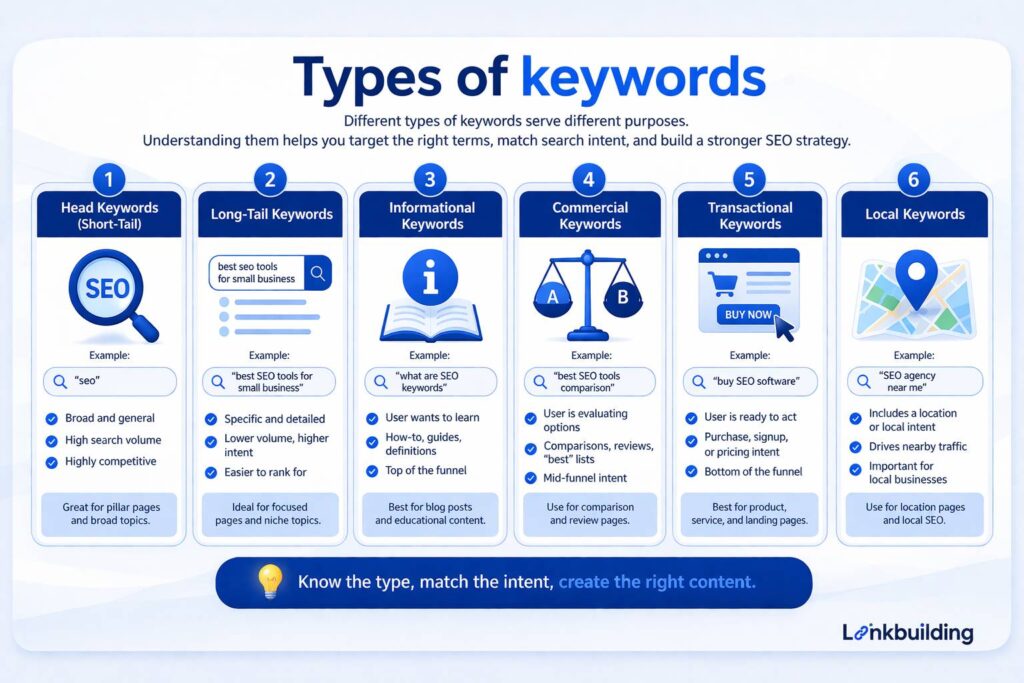
For example, someone searching for “SEO” is using a broad keyword with wide informational intent. Someone searching for “best SEO tools for small business” is using a more specific, comparative phrase. Someone searching for “SEO agency near me” has a local commercial intent. These are all keywords related to search marketing, but they are different types of keywords and should not be handled in the same way.
That is why categorising keyword types matters. It helps answer questions such as:
- Should this be a pillar page or a cluster page?
- Is the search informational, commercial, or transactional?
- Does this keyword need a broad guide or a focused landing page?
- Should multiple related phrases be covered together or separately?
- How should this page connect to the wider content cluster?
Without that framework, keyword targeting tends to become too simplistic.
Why Types of Keywords Matter
Types of keywords matter because search intent, page structure, and SEO performance are closely connected. A keyword strategy becomes much stronger when the site understands what kind of search it is targeting and why.
They help match content to search intent
One of the biggest reasons types of keywords matter is that they help align content with user expectations.
An informational keyword usually needs educational content. A transactional keyword usually needs a product, service, or category page. A commercial investigation keyword often needs a comparison, review, or evaluation page. If those distinctions are ignored, the page may target the right topic but still fail because it uses the wrong format.
They improve site structure
A website building topical authority needs more than content volume. It needs clear content relationships.
Types of keywords help define those relationships. Broad informational keywords often support pillar pages. Narrower question-based or long-tail queries often support cluster pages. Commercial and transactional terms may belong to service or conversion-focused pages. This makes internal linking more logical and reduces duplication.
They support better prioritisation
Some keyword opportunities look attractive in a tool but are not the right fit for the site’s current authority, business goals, or content structure. Understanding keyword types helps with prioritisation because it provides context.
A low-volume long-tail keyword with clear intent may be more valuable than a broad head term that is highly competitive and too vague. Keyword types help you make that distinction.
They reduce content overlap
Websites often create too many pages around similar keywords because they have not clearly identified how those keywords differ. Once keywords are grouped by type and intent, it becomes easier to decide which belong together on one page and which deserve separate pages.
That improves clarity for both users and search engines.
How Types of Keywords Work in SEO
Types of keywords work by helping map search behaviour to the right content format, page role, and internal structure.
Keywords can be grouped by intent
One of the most useful ways to classify types of keywords is by search intent.
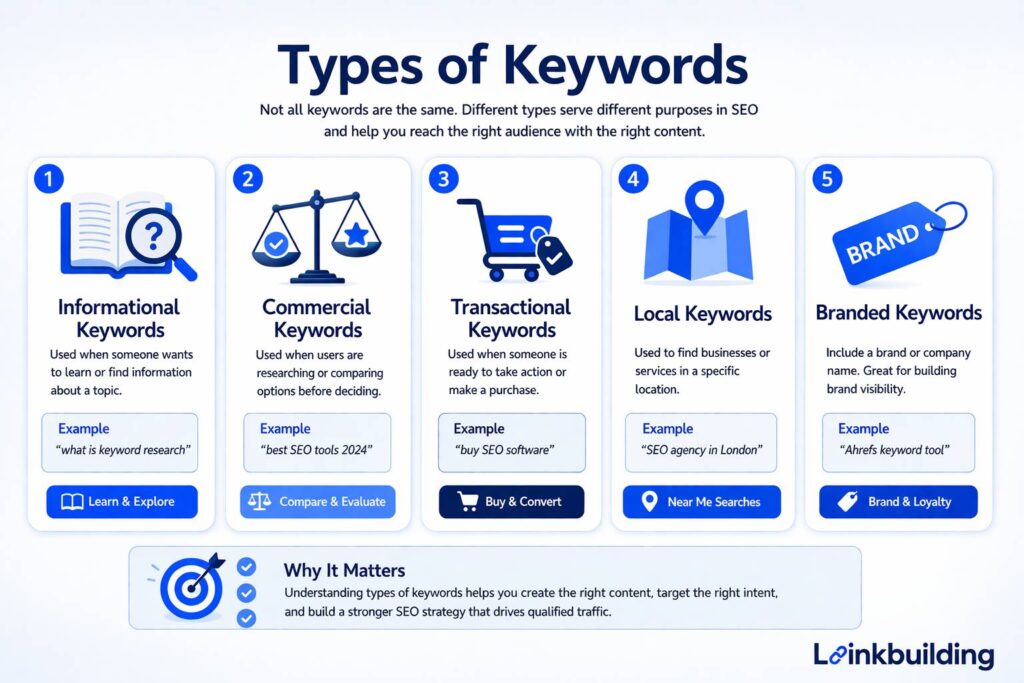
Informational keywords
Informational keywords are used when someone wants to learn, understand, or explore a topic. These keywords often trigger guides, definitions, tutorials, and explanatory articles.
Examples include searches like “what is keyword research,” “why keyword research matters,” or “types of keywords.”
These often work well as blog articles, resource pages, or cluster content within a broader topic section.
Commercial keywords
Commercial keywords usually appear when a user is evaluating options before taking action. They often include terms related to comparison, reviews, tools, or best-of searches.
These keywords typically support pages such as comparison articles, roundups, or detailed reviews.
Transactional keywords
Transactional keywords suggest that the user is ready to act. That action may involve buying, signing up, requesting a quote, or contacting a provider.
These keywords often belong on product pages, service pages, or landing pages designed to convert rather than only inform.
Navigational keywords
Navigational keywords are used when someone already knows the destination and wants to reach a specific brand, product, or page.
These are usually less useful for topic-based content strategy unless they involve your own brand or important brand-adjacent searches.
Keywords can be grouped by specificity
Another useful way to classify types of keywords is by how broad or specific they are.
Head keywords
Head keywords are broad, short phrases with wide meaning. They often have large search volume, but they also tend to be competitive and less precise.
A term like “SEO” or “keywords” is a head keyword. These often suit high-authority sites, major pillar pages, or homepage-level themes rather than narrow articles.
Long-tail keywords
Long-tail keywords are more specific phrases that usually reflect clearer intent. They often have lower search volume individually, but they can be highly valuable because they align closely with what the user needs.
For example, “types of keywords in SEO” is more specific than “keywords.” Long-tail phrases are often ideal for cluster pages because they allow focused coverage of narrower topics.
Keywords can be grouped by branding
Keyword strategy also often separates branded and non-branded searches.
Branded keywords
Branded keywords include a company, product, or service name. These searches are useful for brand visibility and conversion pathways, but they are not always central to educational SEO content unless the page specifically addresses branded demand.
Non-branded keywords
Non-branded keywords do not include a brand name. They are especially important for discovery because they help users find your website before they know who you are.
Most informational cluster pages are built around non-branded keywords.
Important Types of Keywords to Understand
Although there are many ways to classify keyword types, a few categories are especially useful in content strategy and on-page SEO.
Informational keywords
These are often the foundation of topical authority. They allow a website to answer core questions, define concepts, and support broader themes through cluster content.
A site building a Keyword Research section, for example, might use informational pages to cover what keyword research is, why it matters, SEO keywords, and types of keywords.
Long-tail keywords
Long-tail keyword targeting is often one of the most practical ways to build visibility, especially for growing websites. These keywords are more focused, easier to align with intent, and often better suited to specific cluster pages than broad head terms.
Local keywords
Local keywords include geographic intent, either explicitly through location terms or implicitly through queries that trigger local results. These matter most for businesses that serve defined areas.
A keyword like “SEO consultant in Manchester” is different from a general informational phrase and usually needs a page built for local relevance.
Commercial investigation keywords
These keywords sit between information and action. Users are comparing, reviewing, or narrowing options. They are useful because they often connect informational traffic to later conversion behaviour.
Common Mistakes When Using Different Types of Keywords
Understanding types of keywords is useful, but many SEO strategies still go wrong because the categories are applied too loosely or not applied at all.
Treating all keywords the same
One of the most common mistakes is assuming every keyword should be targeted with the same type of article. That leads to mismatched pages, weak intent alignment, and poor user experience.
A broad informational keyword should not be treated like a service query, and a transactional keyword should not be handled like a general guide.
Creating separate pages for every variation
Not every keyword variation represents a different keyword type or a different need. Some phrases belong together on one strong page. Splitting them too aggressively creates thin content and internal competition.
This is where keyword clustering matters. Closely related variations with similar intent are often better covered together.
Focusing only on search volume
Search volume can be useful, but it does not explain the keyword type, the intent behind the search, or whether the keyword fits the site’s structure.
A lower-volume keyword with strong intent and clear relevance may be a better opportunity than a broad phrase that is too competitive or too vague.
Ignoring how keyword types affect internal linking
Keyword types influence how pages relate to each other. If a site does not account for that, the cluster structure becomes messy. Informational guides, commercial pages, and supporting subtopics need clear roles so internal links feel natural and purposeful.
Practical Guidance for Using Types of Keywords Well
The best way to use types of keywords is to apply them during planning, not just after content is written.
Start by defining the topic area you want the site to own. Then group keyword opportunities by intent, specificity, and business role. From there, decide which keywords belong on pillar pages, which belong on cluster pages, and which belong on commercial or transactional landing pages.
A practical workflow usually looks like this:
- identify the broad topic area
- collect related search terms and variations
- classify them by keyword type and search intent
- group similar terms into clusters
- assign each cluster to the most appropriate page type
- connect those pages with internal links that reflect the topic hierarchy
In a pillar-and-cluster model, this process is especially valuable. A broad pillar page on Keyword Research can support a network of focused cluster pages such as what keyword research is, why keyword research matters, SEO keywords, and types of keywords. Each page has a distinct role, but together they strengthen the broader topic section.
Timing and Expectations
Understanding types of keywords can improve planning immediately, but the SEO results still depend on execution.
Once pages are aligned with the right keyword types, the site usually becomes more coherent. Content roles are clearer, internal linking improves, and topic coverage becomes easier to manage. Rankings and traffic growth, however, still take time because search engines need to evaluate the pages within a competitive landscape.
The value of keyword categorisation is often visible first in strategy quality. The site publishes more deliberately, avoids duplication more often, and builds a stronger foundation for long-term growth.
Conclusion
Types of keywords matter because not all searches mean the same thing, and not all pages should serve the same purpose.
When you understand types of keywords, you can build content that matches intent more accurately, structure the site more clearly, and create stronger relationships between pillar pages, cluster pages, and commercial assets. That leads to better relevance, better user experience, and a more disciplined SEO strategy overall.
For a site building topical authority, this is especially important. A keyword is not just a phrase to target. It is a signal that helps define what kind of page should exist, how focused it should be, and how it should contribute to the wider content structure. Used strategically, keyword types help turn scattered SEO activity into a more coherent and effective system.