
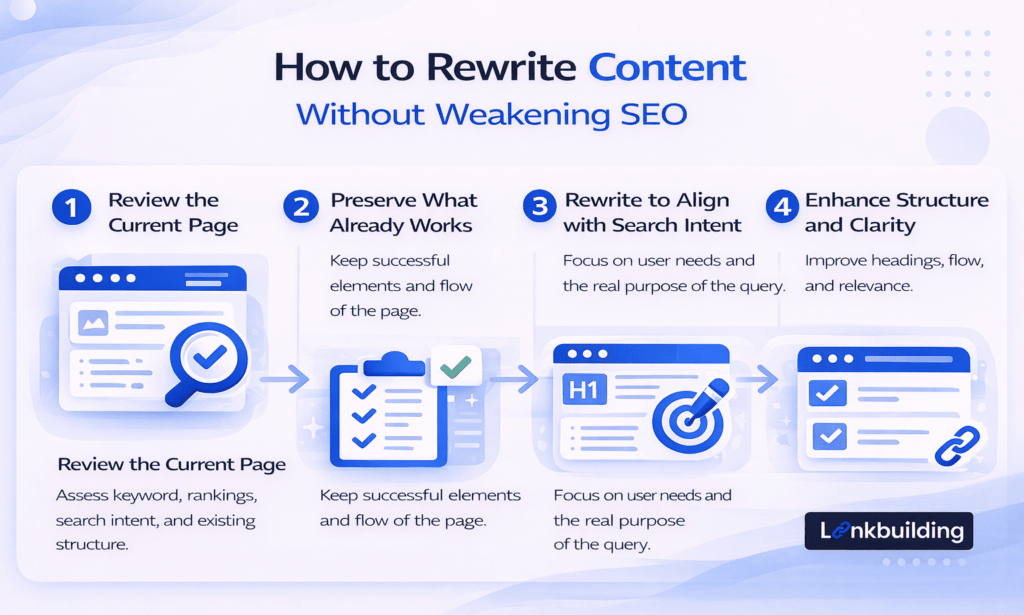

How to Rewrite Content Without Weakening SEO
To rewrite content well, you need to do more than change wording. In SEO, rewriting is a strategic decision. Done properly, it can improve clarity, strengthen search intent alignment, refresh outdated pages, and help existing content perform better. Done poorly, it can remove what already works, weaken relevance, and disrupt rankings.
That is why rewriting should not be treated as a simple editing task. For websites building topical authority through a pillar-and-cluster model, every rewrite needs to support the page’s role in the broader structure. A cluster page should stay focused, useful, and distinct. It should not drift into a generic SEO article or duplicate another page in the same topic group.
This article explains what it means to rewrite content, why it matters for SEO, how to do it properly, and what mistakes to avoid.
What Does It Mean to Rewrite Content?
To rewrite content means revising an existing page so it becomes clearer, more relevant, more useful, or better aligned with its purpose.
In practical terms, rewriting can include updating outdated sections, improving structure, tightening weak explanations, changing the angle to match search intent, or replacing thin content with something stronger. It can also mean reworking a page that targets the wrong keyword or overlaps too much with another article.
Rewriting is not the same as superficial rewording. Swapping sentences for synonyms is not a meaningful SEO strategy. A strong rewrite improves the substance of the page, not just the phrasing.
That distinction matters. Search engines do not reward content simply because it sounds different. The value comes from making the page more useful and more strategically aligned.
Why Rewriting Content Matters
Most websites have pages that are no longer strong enough in their current form. Some were written too quickly. Some no longer match the current search results. Some are still relevant but need clearer structure or better coverage.
Rewriting content matters because it helps you improve what already exists instead of constantly starting from zero.
It helps recover underperforming pages
A page may rank poorly not because the topic is weak, but because the execution is weak. The page may be too broad, too thin, outdated, or poorly aligned with intent. Rewriting can fix those problems without abandoning the original asset.
It supports search intent more accurately
Search intent changes how a page should be written. If the current page misses the real purpose behind the query, a rewrite can reposition it. In many cases, that matters more than adding more keywords.
It improves content quality
Some pages need stronger explanations, better flow, tighter sections, or clearer practical guidance. Rewriting gives you a chance to improve quality without losing the topic relevance the page may already have built.
It strengthens the site structure
In a pillar-and-cluster model, rewriting can help clarify the role of a page within the topic architecture. A weak cluster page can be rewritten so it supports the pillar topic more clearly and connects better to related supporting content.
How to Rewrite Content Properly
The best way to rewrite content is to start with strategy, not wording.
Review the page before changing it
Before you rewrite content, understand what the page is doing now.
Look at the target keyword, current rankings, search intent, internal links, and whether the page still fits the cluster. Check whether it already performs for useful queries or whether it attracts the wrong audience. A rewrite should be based on diagnosis, not assumption.
Decide what needs to change
Not every page needs a full rewrite. Some only need better structure or updated examples. Others need a more substantial rework because the topic angle is wrong or the content is too weak to compete.
A useful way to think about rewriting is to ask:
- Is the topic still right?
- Is the intent correct?
- Is the content too thin or too broad?
- Is the page outdated?
- Does it still fit the site architecture?
These questions help determine whether the page needs light revision or a full rewrite.
Keep what already works
One of the biggest mistakes in SEO rewriting is replacing strong sections without a reason. If the page already ranks for relevant terms, has useful internal links, or contains sections that clearly satisfy intent, those parts should be protected where possible.
Rewriting content should improve value, not erase working signals unnecessarily.
Improve structure and clarity
Many weak pages are not failing because the topic is wrong. They are failing because the page is hard to follow.
A rewrite often works best when it improves:
- heading structure
- paragraph clarity
- topic flow
- relevance of subtopics
- readability
- logical progression from question to answer
That kind of improvement helps both users and search engines.
Rewrite for intent, not just for style
If a page is supposed to answer an informational query, the rewrite should focus on delivering a clear, useful explanation. If the intent is commercial investigation, the content may need comparison, evaluation, or stronger decision-support language.
Style matters, but intent matters more. Good rewriting sharpens the page’s fit with what the searcher actually wants.
Important Subtopics Within Content Rewriting
Rewriting content touches several related SEO disciplines.
Search intent
Intent is often the main reason a rewrite becomes necessary. A page can be technically optimized and still underperform because it answers the wrong version of the question.
Content overlap
Sometimes a page needs rewriting because it competes with another article on the same site. In that case, rewriting may involve narrowing the topic, changing the angle, or consolidating overlap so the page has a clearer role.
Content freshness
Not all pages need constant updates, but some lose value when examples, terminology, or recommendations become outdated. Rewriting can restore relevance without changing the core topic.
Internal linking
A rewritten page should still support the wider site structure. That means reviewing links to the relevant pillar page, nearby cluster pages, and supporting resources where appropriate.
Common Mistakes
A lot of teams rewrite content in ways that create more problems than they solve.
Rewriting without understanding current performance
If you do not review what the page already ranks for, you can accidentally remove sections that support visibility. That is one of the fastest ways to weaken a page that had some SEO value.
Changing wording without improving substance
A shallow rewrite may make the text sound different, but that does not mean it is better. If the page still lacks depth, clarity, or intent alignment, performance may not improve.
Making the page too broad
When rewriting, it is easy to add too much and drift into adjacent topics. That often weakens focus, especially on cluster pages that should answer one main query clearly.
Ignoring the rest of the cluster
A rewrite should strengthen the page’s place within the topic structure. If the page starts overlapping more heavily with nearby content, the rewrite may create cannibalization instead of solving problems.
Practical Guidance
If you need to rewrite content, start with the pages that have the clearest opportunity.
That usually means pages that already have some visibility, pages that are outdated but still relevant, or pages that target important keywords but underperform because execution is weak.
A practical rewrite workflow looks like this:
- review the page’s current role and keyword target
- check search intent and compare against the current SERP
- identify weak, outdated, overlapping, or unclear sections
- preserve useful elements that already support performance
- rewrite for clarity, relevance, and stronger structure
- review internal links and on-page SEO after the rewrite
This process keeps rewriting strategic. It prevents the common mistake of treating every page as if it needs to be rebuilt from scratch.
For sites with larger content libraries, rewriting should also connect to broader content audit work. Sometimes the right decision is to rewrite. Sometimes it is better to merge, redirect, or remove a page entirely.
Timing and Expectations
A rewrite can improve SEO performance, but timing depends on what changed and how strong the page already was.
A focused rewrite on an existing page can show results relatively quickly if it fixes a clear problem, such as weak intent alignment or outdated content. More competitive queries may take longer, especially if stronger authority, internal linking, or broader site improvements are also needed.
It is also important to stay realistic. Rewriting content increases the page’s chances of performing better, but it does not guarantee immediate ranking gains. The strongest results usually come when rewriting is part of a broader content optimization strategy rather than an isolated edit.
Conclusion
To rewrite content properly, you need to improve more than wording. You need to make the page clearer, stronger, more relevant, and better aligned with search intent.
That is what separates a useful rewrite from a cosmetic one.
For SEO, rewriting is often one of the most effective ways to improve existing assets without starting over. It helps recover weak pages, refresh outdated material, sharpen topic focus, and strengthen the role of a page within a cluster structure.
For websites building topical authority, that matters. Every page should have a clear purpose. Every rewrite should support that purpose more effectively. When done well, rewriting content is not about making a page sound different. It is about making it deserve better performance.