

How to Evaluate and Improve Existing Content for SEO
Publishing content is only one part of SEO growth. Over time, most websites accumulate pages that are outdated, underperforming, overlapping, or no longer aligned with search intent. Some pages still have value but need improvement. Others dilute site quality, compete with stronger pages, or attract the wrong traffic.
That is where a content audit becomes important.
A content audit helps you review what already exists, assess how well it performs, and decide what to improve, consolidate, redirect, or remove. For websites building topical authority through a cluster model, this is not just a housekeeping exercise. It is a strategic way to strengthen relevance, reduce waste, and make the site architecture more effective.
This article explains what a content audit is, why it matters, how it works in practice, and what businesses should focus on if they want to use audits to improve SEO performance.
What Is a Content Audit?
A content audit is the process of reviewing the pages on a website to evaluate their quality, relevance, performance, and strategic role.
In practical terms, it means creating a clear view of what content exists, how each page is performing, whether it still supports the site’s goals, and what action should be taken. That action may include updating, merging, redirecting, keeping, or removing content.
A proper content audit is not just an inventory. It is a decision-making process.
The goal is not to judge pages in isolation. The goal is to understand how each page contributes to the website as a whole. A page may have low traffic but still serve an important internal linking role. Another may rank decently but target the wrong query. A third may attract visits but offer little business value. A good audit identifies those distinctions.
Why a Content Audit Matters
Many SEO problems are not caused by a lack of content. They come from unmanaged content.
As sites grow, common issues appear:
- overlapping pages targeting similar keywords
- outdated articles with declining relevance
- thin pages that add little value
- old posts with broken internal links
- cluster content that no longer supports the pillar topic properly
- pages that attract impressions but fail to earn clicks or conversions
A content audit helps bring order to that situation.
It improves topical focus
A strong site architecture depends on clarity. Each page should have a defined role, especially in a pillar-and-cluster model. A content audit helps identify which pages support the topic properly and which ones create confusion or duplication.
It supports better rankings
Search performance is often limited by weak or overlapping content. When multiple pages compete for similar intent, or when outdated pages remain indexed without clear value, the site can lose focus. Auditing content helps reduce cannibalization and strengthen the right pages.
It improves user experience
From the user’s perspective, poor content management often shows up as repetition, outdated information, inconsistent quality, or dead-end pages. A content audit helps improve the overall experience by making the site more coherent and useful.
It creates better use of existing assets
In many cases, the fastest SEO gains come from improving pages that already exist rather than publishing entirely new ones. A content audit helps surface those opportunities.
How a Content Audit Works
A content audit should be structured enough to produce useful decisions, but not so complicated that the process becomes unmanageable.
Start by defining the purpose
Before reviewing pages, decide what the audit is meant to achieve.
Some audits are primarily SEO-focused. Others are meant to improve conversions, align messaging, clean up legacy content, or support a site migration. In most cases, several goals overlap, but one primary objective should guide the process.
For an SEO-driven cluster site, the purpose is usually to improve relevance, strengthen internal structure, and raise the quality of existing content.
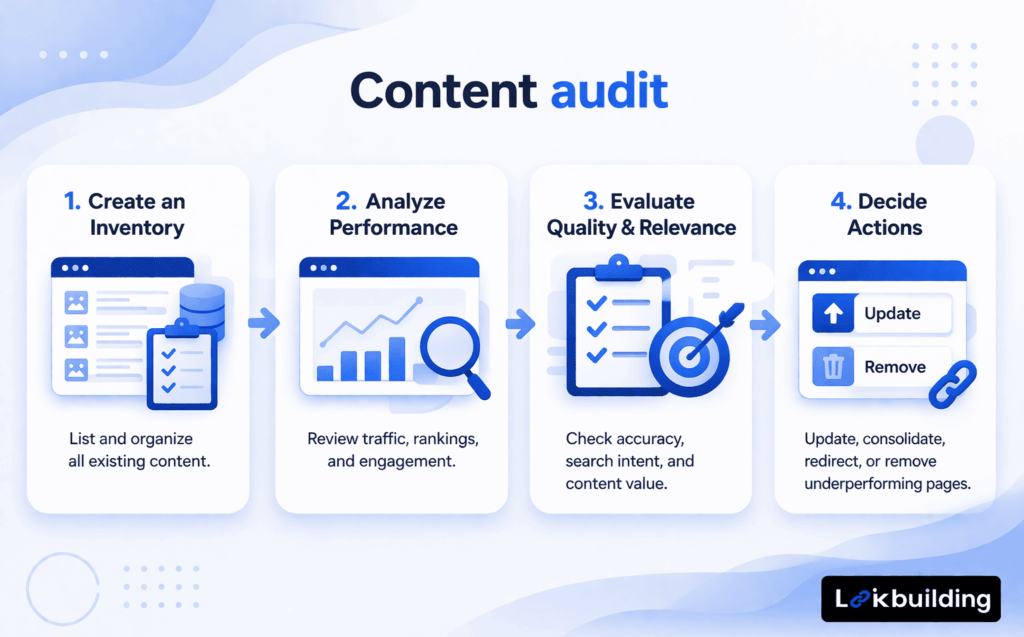
Create a content inventory
The next step is to collect the pages you want to review.
That usually includes URLs, titles, content type, traffic data, target keywords, internal link context, and status indicators such as indexability or conversion relevance. The point is not to build a perfect spreadsheet for its own sake. The point is to create a workable overview.
For smaller sites, this can be relatively simple. For larger sites, the inventory phase may require segmentation by content type, topic cluster, or business importance.
Evaluate page quality and strategic fit
Once the inventory is in place, review each page using both performance data and qualitative judgment.
Ask questions such as:
- Does this page target a clear query?
- Is the search intent still correct?
- Is the content accurate and current?
- Does it support the relevant pillar or topic cluster?
- Is it stronger than similar pages on the site?
- Does it attract useful traffic?
- Does it contribute to conversions or authority?
This is where a content audit becomes strategic. Raw metrics alone are not enough. A page with low traffic is not automatically a failure. A page with traffic is not automatically worth keeping unchanged.
Assign a clear action
Every page should lead to a practical decision.
Common outcomes include:
- keep as is
- update and improve
- consolidate with another page
- redirect to a stronger page
- remove from the index
- delete if it no longer has value
The mistake many teams make is auditing content without defining the next step. A good audit should end with clear actions, not vague observations.
Important Subtopics Within a Content Audit
A content audit becomes more useful when it accounts for the supporting factors that affect performance.
Search intent alignment
One of the most valuable parts of a content audit is checking whether each page still matches the query it appears to target.
Some pages were written around a keyword rather than around intent. Others may have matched intent when they were created but no longer fit the current SERP. Reviewing intent helps identify pages that need repositioning rather than just editing.
Content cannibalization
Cannibalization happens when multiple pages compete for similar queries or intent. This can weaken relevance, split authority, and create confusion for search engines.
A content audit helps identify where pages overlap and where consolidation would strengthen the site.
Internal linking and cluster support
A page should not be judged only by standalone traffic. In a topical cluster, some pages are valuable because they strengthen internal linking, support authority, and guide users deeper into the topic.
A content audit should review how pages connect to the main pillar page and to related cluster content. Weak or missing internal links often reduce the value of otherwise strong pages.
Content freshness and accuracy
Not every page needs constant updates, but some topics lose value quickly if they become outdated. A content audit helps identify where accuracy, examples, terminology, or recommendations need revision.
Common Mistakes
Many businesses attempt a content audit but get limited value because the process is too superficial or too rigid.
Treating it as a traffic-only exercise
Traffic matters, but it is not the only metric that matters. A page may support conversions, authority, or internal linking even if it does not bring in large volumes of traffic.
Reviewing pages without context
A page should be assessed in relation to the rest of the site. Without that context, it is easy to keep duplicate pages, remove strategically useful ones, or miss structural problems.
Keeping weak pages because they exist
Some content stays live simply because someone once published it. That is not a strategic reason to keep a page. If it adds little value, does not fit the cluster, and weakens quality overall, it may need to be consolidated or removed.
Updating everything equally
Not all content deserves the same level of attention. A good audit helps prioritize based on business value, search opportunity, and structural importance.
Practical Guidance
A useful content audit starts small and stays focused.
If the site is large, begin with one cluster or one content category rather than trying to audit everything at once. Review the pages that matter most for SEO performance, commercial relevance, or topical authority.
As you work through the audit, focus on decisions that strengthen the structure of the site:
- improve pages with clear potential
- merge overlapping articles
- remove thin or outdated content that adds no value
- strengthen internal links between related pages
- align cluster pages more clearly with the pillar topic
It is also helpful to document why a decision was made. That reduces confusion later and makes the process easier to repeat.
For teams producing content regularly, a content audit should not be treated as a one-time cleanup. It should be part of ongoing content governance.
Timing and Expectations
A content audit can reveal problems quickly, but the impact of the changes takes time.
Some results may appear relatively soon, especially when outdated pages are improved, overlapping content is consolidated, or internal links are strengthened. In other cases, gains take longer because search engines need time to reassess content changes and site structure.
The size of the site also affects the process. A small cluster audit may be manageable in days. A large site-wide audit can take weeks or longer, especially if implementation requires coordination across SEO, content, and development teams.
The key is to treat a content audit as a staged process. The audit itself is the diagnosis. The real SEO impact comes from acting on what it reveals.
Conclusion
A content audit is one of the most practical ways to improve SEO without starting from zero.
It helps you understand what content you have, how well it performs, where the structural weaknesses are, and which pages deserve to be improved, merged, redirected, or removed. More importantly, it helps turn a growing content library into a more focused, useful, and strategically aligned system.
For websites using a pillar-and-cluster model, that matters even more. Topical authority depends on clarity, depth, and structure. A content audit helps protect all three.
Done properly, a content audit is not just about cleaning up old pages. It is about making the entire content system stronger, more relevant, and better positioned to perform over time.