

Technical SEO vs On-Page SEO: What Matters, What Changes, and How They Work Together
Many SEO discussions treat technical SEO and on-page SEO as separate disciplines. In practice, they are closely connected. One shapes how search engines access and interpret a website, while the other shapes how individual pages communicate relevance, quality, and intent.
That is why technical SEO vs on page SEO is a useful comparison. It helps clarify where each discipline begins, where they overlap, and why strong organic performance usually depends on both. A page can have excellent on-page optimization and still struggle if technical barriers prevent search engines from crawling or indexing it properly. At the same time, a technically clean website will not rank well if its pages fail to match search intent or communicate topical relevance clearly.
This article explains the difference between technical SEO and on-page SEO, why both matter, how they work in practice, and what businesses often misunderstand when trying to prioritize one over the other.
What Is Technical SEO vs On-Page SEO?
Technical SEO and on-page SEO are both core parts of search engine optimization, but they focus on different layers of performance.
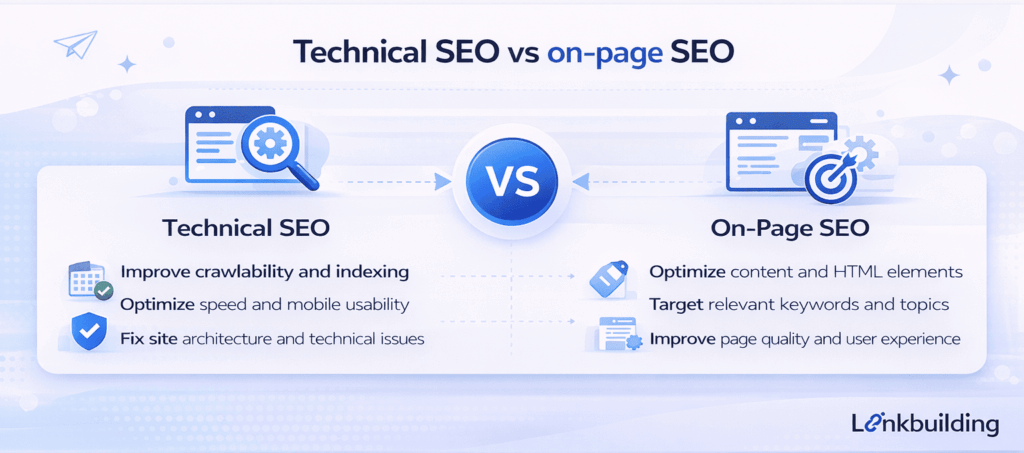
Technical SEO improves the website’s infrastructure so search engines can crawl, understand, and index the site efficiently. It focuses on how the site functions.
On-page SEO improves the content and page-level elements that help search engines understand what a page is about and why it should rank for a specific query. It focuses on how the page communicates relevance.
In simple terms, technical SEO helps search engines reach and process the page. On-page SEO helps them interpret the page’s meaning and value.
That distinction is useful, but it should not be treated too rigidly. Some elements sit close to both areas. Internal linking, for example, influences crawlability and structure, but it also supports relevance and context.
What Technical SEO Covers
Technical SEO deals with the systems and signals that affect how search engines access and process a website.
Common areas include:
- crawlability
- indexability
- site architecture
- URL structure
- canonical tags
- XML sitemaps
- redirects
- mobile usability
- page speed
- Core Web Vitals
- structured data
- HTTPS and security
A technical SEO issue usually affects how pages are discovered, rendered, or stored in the index. For example, if important pages are blocked, buried too deep, duplicated across multiple URLs, or weakened by poor site structure, rankings may suffer even when the content itself is strong.
What On-Page SEO Covers
On-page SEO focuses on the elements that appear on, or are closely tied to, an individual page.
That usually includes:
- title tags
- meta descriptions
- heading structure
- primary topic targeting
- search intent alignment
- body content quality
- keyword placement
- topical depth
- image alt text
- internal anchor usage
- content freshness and clarity
An on-page SEO issue usually affects how clearly a page signals relevance to a topic or query. A page may be indexed and technically accessible, but if the content is weak, unfocused, or poorly aligned with user intent, it will still struggle.
Why the Difference Matters
Understanding technical SEO vs on page SEO matters because websites often focus too heavily on one side.
Some teams spend months refining content while ignoring crawl waste, index bloat, or structural problems. Others become overly focused on technical audits while neglecting content quality and search intent.
Neither approach works well long term.
Technical SEO protects visibility
Technical SEO helps ensure the right pages are discoverable, crawlable, indexable, and technically trustworthy. Without that foundation, even strong pages may underperform.
On-page SEO drives relevance
On-page SEO helps each page compete for the right query. It turns a technically accessible URL into a page that deserves visibility based on quality, structure, and intent match.
Both shape topical authority
For websites using a cluster model, both areas matter even more. Technical SEO supports crawl paths, hierarchy, and internal structure across the cluster. On-page SEO makes each article useful, distinct, and aligned with the search intent it targets.
A good cluster does not work because pages merely exist. It works because those pages are technically connected and individually relevant.
How Technical SEO and On-Page SEO Work Together
Technical SEO and on-page SEO are easiest to understand when viewed as layers.
Technical SEO creates the conditions for performance. On-page SEO determines how well a page uses those conditions.
Example: a service page
Imagine a service page targeting a commercial search term.
If the page has a strong title tag, clear H1, well-structured copy, and content aligned with user intent, the on-page SEO may be solid.
But if that page is buried deep in the site, sits behind redirect issues, loads poorly on mobile, or competes with duplicate URL versions, technical SEO problems may still limit its performance.
The reverse is also true. A technically clean page with weak copy and vague topic targeting will not rank well just because it is easy to crawl.
Example: a blog cluster
Now imagine a cluster of educational articles.
Technical SEO helps search engines discover the articles, understand their hierarchy, and interpret how they connect to broader topic pages. On-page SEO helps each article answer a distinct question clearly and completely.
This is where related supporting articles on internal linking, site architecture, canonical tags, and content optimization fit naturally into a broader SEO structure.
Important Differences Between the Two
Technical SEO is often site-wide
Many technical issues operate at the template or site level. A canonical problem, redirect issue, or poor crawl path may affect hundreds or thousands of pages at once.
On-page SEO is often page-specific
On-page SEO is usually evaluated at the URL level. One page may be well optimized, while another targeting a similar topic may be weak, thin, or mismatched to intent.
Technical SEO affects access and clarity
Technical SEO is about whether search engines can process the site correctly and efficiently.
On-page SEO affects meaning and competitiveness
On-page SEO is about whether the page deserves to rank for the topic it targets.
Common Areas of Overlap
The comparison between technical SEO vs on page SEO is useful, but some elements do not fit neatly into only one category.
Internal linking
Internal links support discovery, crawl efficiency, page relationships, and authority flow. They also reinforce contextual relevance between related pages. That makes internal linking one of the clearest overlap areas.
Structured data
Structured data is usually considered technical SEO because it involves markup and implementation. But it also supports page understanding at the content level, especially when tied to page type and entity meaning.
Page experience
Site speed and mobile usability are primarily technical, but their impact is felt directly on the page experience. In practice, the user does not separate technical quality from content quality.
Common Mistakes When Comparing Technical SEO vs On-Page SEO
Treating technical SEO as optional
A common mistake is assuming technical SEO only matters for very large websites. Large sites often feel technical issues more sharply, but smaller sites still need clean crawl paths, logical structure, and index control.
Treating on-page SEO as keyword placement only
On-page SEO is not just adding keywords to headings and paragraphs. It is about intent alignment, content usefulness, clarity, and depth.
Prioritizing one while neglecting the other
Some websites produce technically clean pages with weak messaging. Others publish good content onto poorly structured sites. Both approaches limit results.
Auditing issues without prioritizing impact
Not every issue in a technical audit or on-page review deserves equal attention. The most valuable work usually happens where business importance, search demand, and SEO impact overlap.
Practical Guidance: Which Should You Focus On First?
The honest answer is that most websites need both, but not always in equal measure.
If the site has major crawl, indexation, or structural issues, technical SEO usually deserves early attention because it affects the foundation. If the site is technically stable but pages are weak, unfocused, or misaligned with search intent, on-page SEO may offer a faster path to improvement.
A practical way to decide is to ask:
- Are the right pages being crawled and indexed?
- Are those pages technically accessible and clearly structured?
- Do those pages match the intent behind the keywords they target?
- Is the content strong enough to compete?
Those questions usually reveal whether the bigger constraint is technical, on-page, or both.
For websites building topic clusters, this comparison becomes even more useful. A strong pillar or hub page needs technical support through site structure and internal linking, while cluster pages need clear on-page optimization to target distinct informational queries effectively.
Timing and Expectations
Technical SEO and on-page SEO improvements can influence performance on different timelines.
Some technical fixes, such as resolving canonical issues, redirect problems, or blocked pages, may affect crawling and indexing relatively quickly after search engines recrawl the site. On-page improvements often take time to influence rankings because search engines need to reassess quality, relevance, and comparative value.
That said, neither side works like a switch. SEO improvements usually compound rather than appear instantly.
Conclusion
The real answer to technical SEO vs on page SEO is not that one matters more than the other in every situation. It is that they solve different problems.
Technical SEO helps search engines access, crawl, understand, and index your website correctly. On-page SEO helps individual pages communicate relevance, quality, and intent clearly enough to compete.
One builds the foundation. The other makes the page worth ranking.
For websites that want sustainable organic growth, the smartest approach is not to choose between them. It is to make sure the site is technically sound and that each important page is optimized with a clear purpose, strong structure, and real value for the searcher.