

How to Optimize Content for Better SEO Performance
To optimize content well, you need to do more than add keywords to a page. Strong SEO content is built around relevance, search intent, structure, clarity, and usefulness. When those elements work together, content is more likely to rank, attract the right visitors, and support the broader authority of the site.
That is especially important in a pillar-and-cluster model. A cluster page should answer one clear question, stay tightly focused, and strengthen the topic around the main pillar page. It should not try to cover all of SEO. It should help the reader understand one specific area in a practical way.
This article explains how to optimize content properly, why it matters, what the process looks like, and what mistakes to avoid.
What Does It Mean to Optimize Content?
To optimize content means improving a page so it performs better for both users and search engines.
In practice, that includes refining the page’s topic focus, aligning it with search intent, improving readability, strengthening topical coverage, and making sure the page fits into the wider site structure. It also includes on-page SEO elements such as headings, internal links, title tags, and metadata.
The important point is that content optimization is not just technical polishing. It is a strategic process. A page can be grammatically correct and still be poorly optimized if it targets the wrong query, answers the wrong question, or lacks enough depth to compete.
When you optimize content properly, you make it clearer, more relevant, and more useful.
Why It Matters for SEO
Content optimization matters because search engines are trying to rank pages that best satisfy the query. If a page is vague, unfocused, thin, or mismatched to intent, it is harder for that page to perform consistently.
Better alignment with search intent
A page should match what the searcher is actually trying to find.
If someone searches how to optimize content, they usually want a practical explanation, not a dictionary-style definition and not a sales pitch. They want to know what to improve, how to approach it, and what actually makes a difference.
Pages that miss that intent often struggle, even when they include the right keywords.
Stronger relevance and rankings
When you optimize content, you help search engines understand the page more clearly. Better structure, stronger topical focus, and clearer keyword relevance can all improve how competitive the page is in search.
That does not mean every update leads to immediate ranking gains. But it does improve the page’s ability to compete.
Better user experience
Optimized pages are easier to read and easier to trust. They answer the core question quickly, then build depth where needed. That improves engagement and helps the content feel more useful rather than padded.
Stronger topical authority
In a cluster model, every supporting page helps reinforce the main topic. A focused article about how to optimize content can naturally connect to related pages about search intent, on-page SEO, content audits, internal linking, and refreshing old content. That structure helps users and strengthens thematic relevance across the site.
How to Optimize Content
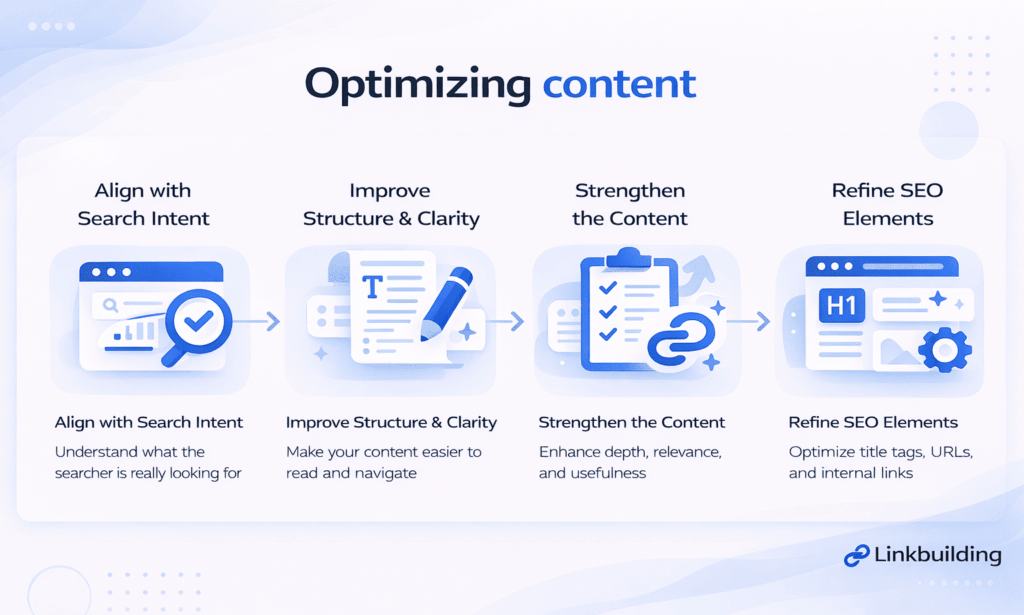
The best way to optimize content is to work in a clear order. Start with strategy, then improve the page itself, then refine the supporting SEO details.
Start with the target query
Every page should have one primary target. Before editing anything, define what keyword or query the page is trying to rank for and what kind of page it needs to be.
For this topic, the page is an informational cluster article. Its role is to explain how to optimize content, not to become a full content marketing guide.
That kind of clarity prevents the page from becoming too broad.
Check search intent first
Search intent should shape the page before you rewrite headings or metadata.
Look at the current results for the target query and ask what type of content is ranking. Is the intent informational, commercial, or mixed? Are the top pages short and direct, or long and detailed? Are they tactical, strategic, or beginner-focused?
If your page does not match that expectation, optimization should begin there.
Improve the structure
A well-optimized page is easy to scan. Readers should understand the flow quickly.
That usually means:
- a clear H1
- logical H2 sections
- H3 subsections only when useful
- short to medium paragraphs
- direct, specific language
- a clear progression from explanation to application
Structure is not cosmetic. It affects how readers engage with the page and how clearly search engines interpret it.
Refine the actual content
This is where most of the real work happens.
To optimize content, review whether the page actually answers the query well. Remove filler. Clarify weak points. Add missing context. Tighten sections that drift off-topic. Expand only where it improves usefulness.
Good optimization is not about making every page longer. It is about making the page more effective.
A strong page usually does four things well:
- it answers the main question clearly
- it covers the topic with enough depth
- it avoids unnecessary distractions
- it gives the reader a logical next step
Use keywords naturally
Keywords still matter, but they should support the topic rather than control the writing.
Use the primary phrase where it belongs: in the title, main heading, introduction, and relevant body copy. Then support it with related language and semantically connected terms. Avoid repeating the exact keyword excessively. That rarely improves performance and often makes the page feel forced.
If you want to optimize content well, write around the topic, not just around the phrase.
Strengthen internal linking
Internal links are a core part of content optimization, especially on sites built around topical clusters.
A page like this should naturally connect to related articles such as a guide to search intent, a deeper page on on-page SEO, a resource about internal linking strategy, or an article on content audits. Those links help readers move through the topic and help search engines understand how the site is structured.
Internal linking should feel helpful, not inserted for SEO alone.
Improve on-page SEO elements
Once the content itself is strong, refine the supporting elements.
That includes:
- title tag
- meta description
- URL
- heading hierarchy
- image alt text where relevant
- anchor text for internal links
These elements help reinforce relevance, but they should never be the starting point if the page itself is weak.
Important Subtopics That Affect Content Optimization
To optimize content properly, it helps to understand the connected disciplines around it.
Search intent
Intent shapes content quality more than many teams realize. A page can look optimized on the surface and still fail if it answers the wrong kind of question.
On-page SEO
On-page SEO supports content performance through structure and page-level signals. It is part of optimization, but not the whole process.
Content depth
Depth matters when it reflects real usefulness. Thin pages are hard to optimize because there is not enough substance to strengthen. Depth should come from better explanation, not from repetition.
Internal linking and site architecture
A page performs better when it fits into a clear system. Cluster content should support the pillar page and connect logically to related supporting articles.
Common Mistakes
A lot of SEO content is edited without being truly optimized. The same mistakes appear repeatedly.
Focusing on keywords too early
When teams start with keyword placement before clarifying intent and purpose, the result is often mechanical content that sounds optimized but does not help the reader much.
Making the page too broad
A cluster page should stay focused. If a page about how to optimize content starts trying to explain every part of SEO, its relevance weakens.
Updating surface elements only
Changing headings, metadata, or word count does not solve the real problem if the page lacks substance or misses the query.
Ignoring internal context
A page should not be optimized as if it exists alone. It should support the wider topic structure and connect to nearby pages where appropriate.
Practical Guidance
A useful way to review any page is to ask a short set of questions.
Does the page target a clear query? Does it match the likely intent? Is the answer clear in the first part of the article? Is the structure easy to follow? Are the internal links useful? Does the page add something distinct within the cluster?
Then improve the page in the right order: intent first, structure second, content quality third, and on-page refinements after that.
For many websites, the best SEO gains come from improving existing pages that already have some visibility or topical relevance. That is often more efficient than publishing new articles without strengthening the ones already on the site.
Timing and Expectations
When you optimize content, results can appear at different speeds depending on the page and the site.
A page with existing rankings may improve within weeks if the updates fix a clear mismatch or strengthen relevance. More competitive topics can take longer, especially when broader authority or internal linking support is still weak.
The main point is to stay realistic. Optimization improves probability. It does not guarantee instant ranking changes.
Conclusion
To optimize content effectively, you need to improve more than keywords. You need to make the page more relevant, more useful, better structured, and more aligned with what the searcher wants.
That is what makes content stronger in search and more valuable to real readers.
For a site using a pillar-and-cluster strategy, this matters even more. Each cluster page should answer one clear query, support related content, and strengthen the topic as a whole. Content optimization is what helps turn that structure into actual SEO performance.