
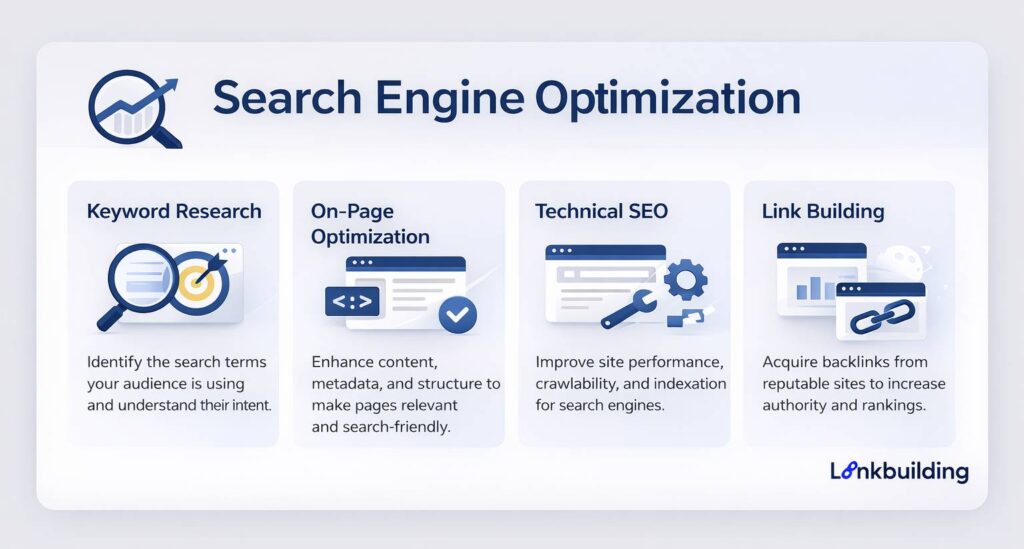

Search Engine Optimization
Search engine optimization is one of the most important disciplines in digital marketing because it shapes how websites earn visibility, attract qualified traffic, and build long-term authority in search. It is often reduced to rankings, keywords, or technical fixes, but effective SEO is broader than that. It is a strategic process that aligns content, site structure, technical performance, and user intent so a website can become a credible answer to the queries that matter most.
For business owners, marketers, and SEO professionals, that distinction matters. A website can publish content consistently and still struggle because the pages are not mapped to the right intent, the internal linking is weak, or the technical foundation prevents search engines from understanding the site properly. Strong SEO is not the result of one tactic. It comes from coordination across multiple areas that all support discoverability and usefulness.
As a pillar topic, search engine optimization also sits at the center of a much broader content cluster. It naturally connects to supporting concepts such as keyword research, on-page SEO, technical SEO, internal linking, link building, SEO competitor analysis, keyword search volume, and long-tail keyword strategy. A good pillar page should not try to replace all of those topics, but it should give readers a clear, strategic understanding of how they fit together. This article follows that structure and the writing requirements you provided for a pillar page.
What Is Search Engine Optimization?
Search engine optimization is the process of improving a website so it can rank more effectively in search engines for relevant queries and attract traffic that matches business goals.
In practical terms, SEO is about helping search engines understand what a page is about, why it is useful, and when it deserves to appear in search results. At the same time, it is about helping users find content that answers their questions, solves their problems, or supports a buying decision.
That means SEO is not just a technical activity and not just a content activity. It sits at the intersection of:
- content quality
- search intent alignment
- site architecture
- crawlability and indexation
- page experience and usability
- authority and trust signals
A page that is well written but poorly structured may struggle to rank. A technically sound page with weak content may also fail. Likewise, a website with many relevant articles can still underperform if it lacks topical organization or internal links that clarify page relationships.
Search engine optimization therefore works best when it is treated as a system rather than a checklist.
Why Search Engine Optimization Matters
SEO matters because search remains one of the clearest ways people discover information, compare options, and evaluate businesses. Visibility in search can influence brand awareness, lead generation, sales, and trust long before a user ever fills out a form or makes a purchase.
It creates sustainable visibility
Paid advertising can generate immediate traffic, but SEO creates the potential for durable visibility over time. A strong page can continue attracting relevant visitors long after it is published, especially when it is supported by a broader topical cluster and updated when needed.
That does not mean SEO is free or automatic. It requires strategy, execution, and patience. But when it works well, it creates a compounding effect that many channels do not.
It aligns content with real demand
One of the clearest strengths of SEO is that it is grounded in search behavior. People reveal what they want through the queries they type into search engines. That makes SEO a powerful way to understand demand and build content around actual needs rather than assumptions.
This is why a topic like keyword research is so closely tied to search engine optimization. Without knowing what users search for, it is difficult to build the right pages or structure a content strategy effectively.
It supports authority and trust
A site that consistently publishes useful, accurate, and well-structured content across a topic area is more likely to be seen as a credible resource. That matters for users, and it also matters for search engines that increasingly assess quality through signals connected to expertise, relevance, and trust.
Topical depth is especially important here. Instead of publishing disconnected articles, a site should build clear relationships between core topics and supporting subtopics. For example, a broad page on search engine optimization should naturally connect to deeper guides on technical SEO, search intent, internal linking, and SEO competitor analysis.
It improves the quality of traffic
SEO is not only about increasing traffic. It is about attracting the right traffic. A site that ranks for irrelevant or loosely related terms may grow visits without improving business outcomes. Good SEO focuses on relevance, intent, and page purpose so that traffic is more likely to engage, convert, or move deeper into the funnel.
How Search Engine Optimization Works
SEO works by improving the signals that help search engines crawl, understand, evaluate, and rank a website’s pages. The process is ongoing because search results are competitive and user expectations change over time.
Search begins with crawling and indexing
Before a page can rank, search engines need to discover it and include it in their index. That depends on crawlability and site structure.
If pages are blocked, buried too deeply, orphaned from internal links, or duplicated in confusing ways, search engines may not interpret them properly. This is why technical SEO and internal linking are foundational. They do not guarantee rankings on their own, but they make ranking possible.
A healthy SEO setup usually includes:
- a logical site structure
- consistent internal links between related pages
- clean URL patterns
- proper canonical handling
- no important pages blocked unintentionally
- pages that load and render properly
These are structural requirements, not ranking shortcuts.
Rankings depend on relevance and usefulness
Once a page is indexed, search engines evaluate how well it matches a query. Relevance is shaped by more than the keyword alone. Search engines assess whether the page addresses the topic clearly, whether it aligns with intent, and whether it provides enough depth and quality to satisfy the search.
This is where on-page SEO becomes essential. Strong pages typically have:
- a clear topical focus
- headings that reflect the subject logically
- content that addresses the search intent directly
- natural use of primary and related keywords
- internal links that add context
- a structure that makes the page easy to scan and understand
The goal is not to repeat the keyword mechanically. It is to build a page that makes semantic and practical sense for the topic.
Authority influences competitiveness
In many search results, especially for broad or commercially valuable topics, authority plays a major role. Search engines are more likely to trust pages and domains that demonstrate strong coverage, quality, and external validation.
This is why link building still matters within SEO. Relevant backlinks can strengthen a page’s credibility and help search engines interpret the site as a more authoritative source. However, links are most effective when they support already strong content and a coherent site structure.
Authority also comes from topical depth. A single article on SEO is less convincing than a site that also publishes strong supporting content on keyword mapping, search engine optimization strategy, long-tail keywords, content optimization, and technical performance.
User experience affects outcomes
SEO is not isolated from usability. Pages that are hard to navigate, slow to load, or difficult to read can limit performance even if they are technically indexable and well targeted.
Search engines aim to surface results that create a good experience. That makes page clarity, mobile usability, content structure, and visual hierarchy part of the broader optimization process.
A page should help users reach the answer efficiently. That is especially important for informational queries, where readers want clarity and structure rather than friction.
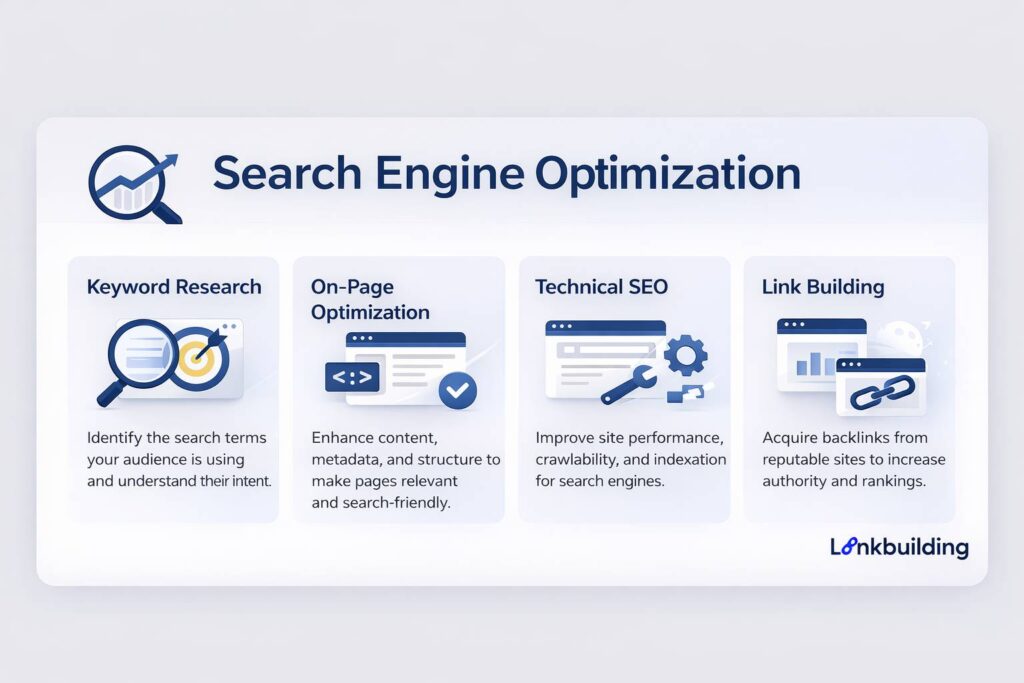
Core Areas of Search Engine Optimization
SEO is easier to understand when broken into its major components. These areas overlap, but each plays a distinct role.
Keyword research and search intent
Keyword research helps identify what people search for, while search intent helps explain why they search for it. Together, they shape the editorial direction of SEO.
A site cannot build strong visibility by targeting keywords in isolation. It needs to understand whether a query calls for a guide, a product page, a comparison, or a local result. Search engine optimization improves when content is mapped to intent correctly.
This is why supporting topics such as keyword search volume, long-tail keywords, and keyword research with Google are useful cluster pages. They deepen the site’s treatment of SEO without duplicating the purpose of the main pillar page.
On-page SEO
On-page SEO refers to the improvements made directly on a page to strengthen relevance and usability. This includes headings, titles, content structure, internal links, metadata, and topical coverage.
Strong on-page work does not rely on formulaic keyword placement. It focuses on communicating the subject clearly and helping both users and search engines understand the page’s purpose.
For example, a strong page about search engine optimization should explain the concept broadly, define its major branches, clarify how SEO works, and direct readers naturally toward deeper supporting topics.
Technical SEO
Technical SEO supports the infrastructure that allows content to be crawled, indexed, and interpreted correctly. It includes issues such as:
- crawl efficiency
- site speed
- duplicate handling
- canonicalization
- structured data where relevant
- XML sitemaps
- rendering and JavaScript considerations
- mobile usability
Technical SEO is often misunderstood as separate from strategy, but that is a mistake. A technically flawed site can prevent even the best content strategy from performing.
Content strategy and topical authority
Modern SEO is increasingly topic driven rather than page driven. Search engines do not just evaluate whether one page uses the right term. They also interpret whether the site demonstrates meaningful coverage of the subject.
This is where a pillar-and-cluster model becomes valuable. A pillar page on search engine optimization can provide the broad framework, while cluster pages explore focused subtopics such as:
- SEO competitor analysis
- keyword search volume
- free keyword tools
- keyword research with Google
- link building cost
- link building ROI
That structure helps distribute relevance across the site and creates stronger internal pathways for both users and search engines.
Internal linking
Internal linking is one of the most overlooked parts of search engine optimization. It helps search engines discover pages, understand relationships between topics, and interpret which pages are most central to a site’s structure.
It also improves usability. A reader on a broad SEO page should be able to move naturally into more specific topics when they need detail. For example, someone learning the basics may next want to explore competitor analysis, keyword research, or how search volume affects prioritization.
Good internal linking is contextual. It should feel helpful, not forced. Exact-match anchors can be used sparingly, but natural anchor variation usually creates a stronger reading experience.
Link building and external authority
Link building refers to earning or acquiring backlinks from other websites. In SEO, backlinks can reinforce credibility and help pages compete more effectively, especially in crowded topics.
That said, link building should not be treated as a substitute for content quality. Weak content rarely becomes strong merely because it has links. The best results come when pages are already useful, structurally sound, and clearly aligned with search demand.
A site building authority in SEO might create strong informational assets, practical guides, and original resources that earn mentions naturally while also pursuing deliberate outreach where appropriate.
Important Subtopics Within Search Engine Optimization
Because SEO is broad, a good pillar page should frame the most important supporting ideas without trying to exhaust them all.
Search intent alignment
Search intent is central to SEO because ranking depends on solving the right problem in the right format. A page can be well optimized technically and still fail because it addresses the wrong intent.
Informational searches often need education and explanation. Commercial searches often need comparison or evaluation. Transactional searches need direct pathways to action. Matching that correctly is one of the clearest differences between superficial SEO and strategic SEO.
Site architecture
Site architecture shapes how topics are organized, how authority flows internally, and how easily search engines can discover and interpret pages.
Poor architecture often creates scattered pages, duplication, and weak internal signals. Strong architecture connects the pillar page to its supporting content in a deliberate hierarchy. For SEO-focused sites, that often means grouping related pages around core concepts rather than publishing disconnected articles.
Content optimization
Content optimization is not about over-editing for keywords. It is about improving relevance, clarity, structure, and completeness.
A page may need stronger subheadings, better intent alignment, more precise definitions, fresher examples, or clearer internal links. In many cases, content optimization is one of the most efficient ways to improve performance because it strengthens assets the site already owns.
Measurement and iteration
SEO requires feedback loops. Rankings, impressions, click-through rates, and engagement patterns can reveal whether a page is earning visibility and satisfying expectations.
Not every SEO improvement comes from creating new pages. Often the better move is to refine targeting, consolidate overlapping content, update outdated sections, or strengthen internal connections between related articles.
Common Search Engine Optimization Mistakes
SEO frequently underperforms because the strategy is fragmented or based on oversimplified assumptions.
Treating SEO as only keywords
Keywords matter, but they are not the whole discipline. When teams focus narrowly on inserting terms into copy, they often ignore intent, structure, technical barriers, and overall usefulness.
Publishing without a clear page role
A strong site needs clear page purpose. If several pages target similar variations without distinct intent, they can compete with one another and weaken the overall structure.
This is especially common when websites publish cluster topics without first defining the role of the pillar page.
Ignoring internal linking
Many websites publish content and then leave pages disconnected. That wastes authority and makes it harder for search engines to interpret which pages matter most.
Overvaluing shortcuts
SEO does not respond well to shortcut thinking. Tactics that promise instant rankings usually ignore the long-term factors that actually support visibility: quality, relevance, structure, and trust.
Failing to revisit existing content
Older content often becomes inaccurate, thin, or misaligned with current search results. Sites that never refresh important pages gradually lose competitiveness, even if they continue publishing new articles.
Practical Guidance for Applying Search Engine Optimization Well
A sound SEO approach starts with foundations and builds outward. The exact tactics depend on the site, but the strategic order matters.
First, clarify the site’s core topics and commercial priorities. Then evaluate how those topics map to search demand and search intent. From there, build a structure in which each major topic has a clear home and supporting pages exist to deepen coverage.
For most websites, that means:
- defining the core topic areas the site should own
- conducting keyword research around those topics
- mapping keywords to distinct pages based on intent
- improving technical foundations so pages can be crawled and indexed reliably
- building strong content that matches the expected format for the query
- adding contextual internal links between pillar and cluster pages
- monitoring performance and refining pages over time
This process is less glamorous than chasing isolated tricks, but it is far more durable.
A practical SEO strategy also respects trade-offs. Not every keyword is worth targeting. Not every ranking opportunity matches business value. The best SEO decisions usually come from balancing search demand, competitiveness, page intent, and the site’s current authority level.
Timing and Expectations
Search engine optimization is a long-term channel. Some improvements, such as fixing indexation issues or strengthening internal links, can produce visible gains relatively quickly. Others, especially those tied to new content and broader authority building, take longer.
For established sites with existing visibility, optimization work can sometimes improve results within weeks or months. For newer sites or highly competitive topics, progress may take longer because the site must build trust and coverage gradually.
It is also important to separate activity from outcome. Publishing articles, adjusting metadata, or earning a few links does not guarantee movement on its own. SEO works best when improvements support one another across content, structure, technical health, and authority.
Realistic expectations are part of good SEO strategy. The goal is not instant dominance. It is steady improvement through relevant, defensible work that compounds over time.
Conclusion
Search engine optimization is the discipline of making a website more discoverable, more understandable, and more useful in search. It is not limited to keywords, rankings, or technical fixes. It combines intent alignment, content strategy, technical quality, internal linking, and authority building into one system.
That is why SEO should be approached strategically rather than tactically. A page can rank because it is relevant, but a site grows because its pages work together. In a pillar-and-cluster model, the strongest results come when the main topic is supported by well-structured subtopics, each with a distinct role and clear internal relationships.
For a website building topical authority, search engine optimization is not just another subject to publish. It is the framework that connects research, content, architecture, and performance into a coherent growth strategy. When done well, it helps a site earn visibility through relevance, depth, and trust rather than through isolated tactics.